
Still seeing fleas in winter in Bristol, TN or Bristol, VA? Learn how indoor heat, humidity, flea pupae and protected areas can keep fleas active indoors.

Cold nights and freezing temperatures can make it seem like flea season should be over. Yet homeowners in Bristol, TN and Bristol, VA may still notice fleas jumping indoors, see their pets scratching, or find signs of activity around carpets, furniture, or pet-resting areas well into winter. That can be confusing when temperatures outside have already dropped below freezing.
Cold weather can reduce flea survival outdoors, especially when fleas and their developing stages are directly exposed to prolonged cold or dry conditions. An infestation inside a home is different. Adult fleas may be protected on a warm animal, while eggs, larvae, and pupae may already be present in carpet fibers, pet bedding, floor cracks, or other protected indoor areas that never reach outdoor temperatures.
That is why waiting for the first frost is not a reliable way to deal with fleas already established inside a house. If flea activity continues indoors through colder weather, [professional flea and mite control — link to Pest Detectives Flea & Mite Control Services] can focus on the environmental part of the infestation rather than relying on winter weather to interrupt the flea life cycle.
Fleas in Winter in Bristol, TN & Bristol, VA: Why Can They Still Be Active Indoors?
Some fleas and developing flea stages can be affected by prolonged cold weather, but winter does not automatically eliminate every flea. The result depends heavily on where the flea is located and what conditions it is actually exposed to. A flea outdoors in an exposed area faces a very different environment from a flea living on a dog or cat inside a heated house.
Outdoor cold can slow development and reduce survival when fleas are exposed to unfavorable conditions for long enough. Adult fleas living on an animal are buffered by the animal's body heat, while immature flea stages inside a home may remain in protected areas that never experience freezing temperatures. Indoor heating can also maintain conditions that allow flea activity to continue even when temperatures outside are much lower.
The practical answer is that winter can suppress exposed outdoor flea populations without automatically eliminating an indoor infestation. If fleas have already established themselves inside a Bristol home, freezing weather outside may have little immediate effect on what is happening in carpets, pet-resting areas, furniture zones, or other sheltered parts of the property.
Outdoor winter and indoor winter are not the same environment
One of the biggest reasons winter flea activity seems surprising is that people naturally compare the temperature outside with what they expect fleas to experience everywhere. In reality, fleas can encounter several very different environments around the same property. The temperature on an exposed porch, the temperature deep inside a carpet, and the temperature against a pet's skin are not the same.
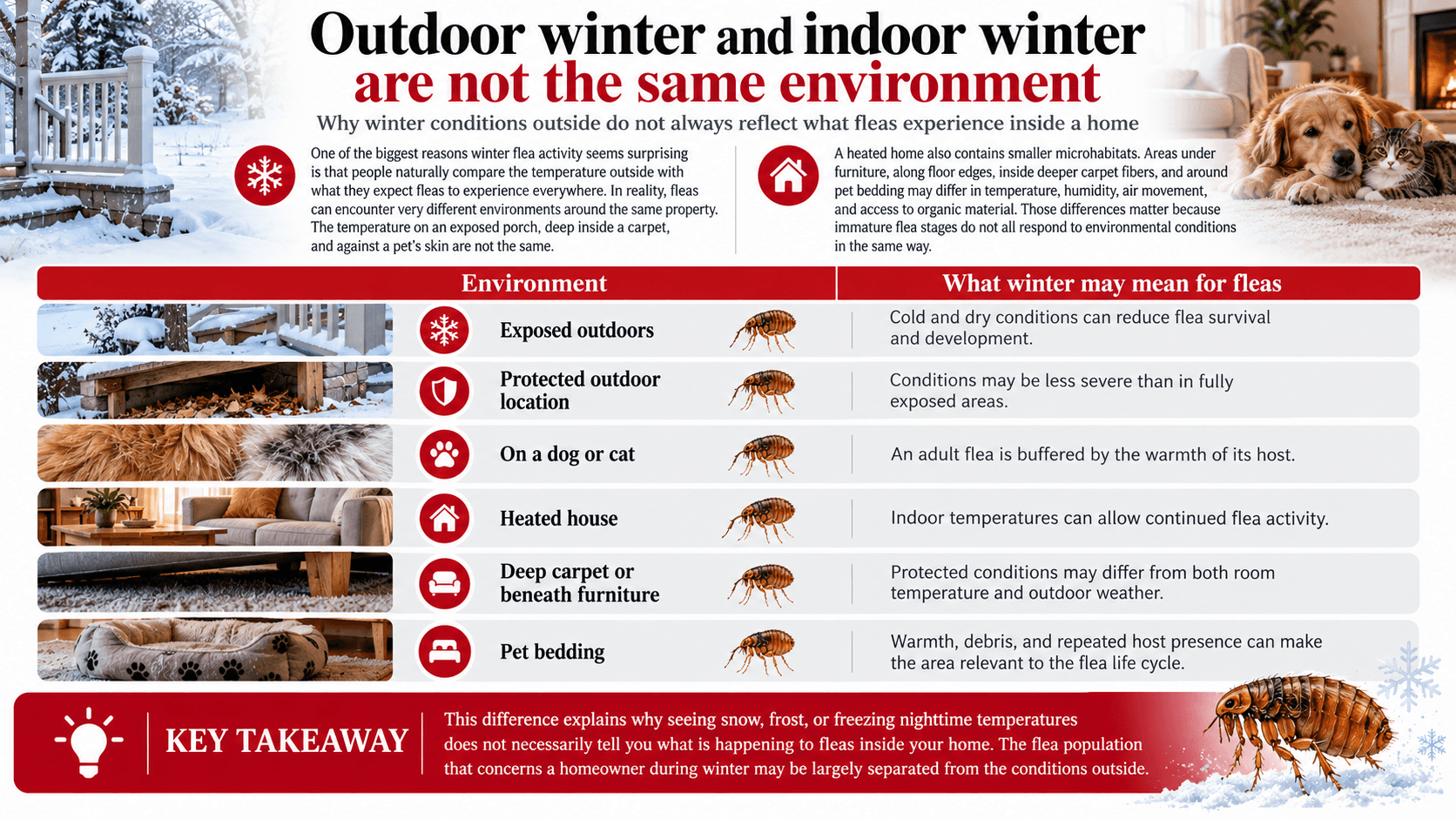
A heated home also contains smaller microhabitats. Areas under furniture, along floor edges, inside deeper carpet fibers, and around pet bedding may have different temperatures, humidity levels, air movement, and access to organic material than the middle of an open room. Those differences matter because immature flea stages do not all respond to environmental conditions in the same way.
Environment | What winter may mean for fleas |
|---|---|
Exposed outdoors | Cold and dry conditions can reduce flea survival and development |
Protected outdoor location | Conditions may be less severe than in fully exposed areas |
On a dog or cat | An adult flea is buffered by the warmth of its host |
Heated house | Indoor temperatures can allow continued flea activity |
Deep carpet or beneath furniture | Protected conditions may differ from both room temperature and outdoor weather |
Pet bedding | Warmth, debris, and repeated host presence can make the area relevant to the flea life cycle |
This difference explains why seeing snow, frost, or freezing nighttime temperatures does not necessarily tell you what is happening to fleas inside your home. The flea population that concerns a homeowner during winter may be largely separated from the conditions outside.
Why the first frost does not reset an indoor flea infestation
Frost only affects organisms that are actually exposed to the conditions created by that frost. If flea eggs, larvae, or pupae are already inside a heated home, they are not sitting outdoors in freezing air simply because the weather changed. They may remain in carpets, beneath furniture, around baseboards, in pet-resting areas, or inside small protected cracks.
That is why a freezing night in Bristol does not mean the carpet, pet bedding, or floor areas inside the home reached temperatures that would eliminate every stage of an infestation. Even rooms that feel cooler during winter may still be far warmer and more stable than an exposed outdoor environment.
A homeowner may therefore see fleas after several frosts without the infestation being unusual. The cold weather outside may have reduced outdoor flea activity while leaving an already established indoor population largely separated from those conditions. Winter weather and indoor flea activity can happen at the same time because the fleas are not necessarily experiencing the same winter you are seeing outside.
Which flea life stages can still be present during winter?
The flea life cycle includes eggs, larvae, pupae, and adults. Winter can affect each stage differently, so treating every flea in the home as if it responds to cold in the same way can lead to the wrong expectations.
Adult fleas
Adult fleas are usually associated with a host such as a dog or cat. Once an adult flea is feeding and living on an animal, the outdoor air temperature becomes less relevant because the flea is in direct contact with a warm host. A pet that spends most of its time indoors may therefore continue carrying adult fleas during winter even when outdoor temperatures have fallen sharply.
Removing visible adult fleas is only part of the problem when environmental stages are already present around the home. An adult flea seen on a pet may be the most obvious sign of the infestation, but it does not tell you how many eggs, larvae, or pupae may be present in surrounding areas.
Flea eggs
Flea eggs can fall away from the host and become distributed in the places where pets rest, walk, sleep, or spend time. Their development depends on environmental conditions, so it would be inaccurate to assume that every egg inside a house will develop successfully. Indoor conditions can, however, be much more favorable than winter conditions outside.
Because eggs can be present away from the animal itself, inspecting and addressing only the pet may leave environmental stages in the home. This is one reason flea control often has to account for the property as well as the animal.
Flea larvae
Flea larvae are more sensitive to environmental conditions than adult fleas living on a host. Dryness can be especially unfavorable, which means winter heating may sometimes reduce suitable conditions in exposed indoor areas. That does not mean every part of a home becomes equally dry.
Larvae tend to be associated with protected areas where they are less exposed to light and disturbance. Deeper carpet fibers, spaces beneath furniture, floor edges, and areas around pet bedding can provide different conditions from open parts of a room. The presence of these protected microhabitats is one reason indoor flea development cannot be judged from thermostat temperature alone.
Flea pupae and cocoons
The pupal stage is particularly relevant when homeowners report fleas that seem to appear after activity had slowed down. Flea pupae develop inside protective cocoons, and emergence can be delayed depending on environmental conditions and other cues around them.
This means a flea noticed during winter may have come from a population that became established earlier. Pupae present in the home can remain protected while visible adult activity temporarily seems lower. Later emergence can make it appear as if fleas suddenly returned even though part of the flea population had remained in the environment.
Flea stage | Winter outdoors | Winter indoors |
|---|---|---|
Adult | Exposed cold can be unfavorable | A warm host can protect the adult flea from outdoor conditions |
Egg | Cold or dry conditions may inhibit development | Suitable indoor conditions may allow development |
Larva | More vulnerable to unfavorable environmental conditions | Protected microhabitats may support survival |
Pupa | Environmental conditions affect development and emergence | The cocoon provides protection and emergence can occur later |
Does indoor heating keep fleas alive all winter?
Indoor heating can contribute to continued flea activity because it separates the inside of a house from freezing outdoor conditions. A heated Bristol home may remain warm enough for adult fleas on pets and some environmental flea stages to avoid the cold they would experience outdoors.
Temperature is only part of the picture, though. Humidity, host availability, floor coverings, pet-resting areas, and small protected spaces within the home also affect whether conditions support continued development. A warm room does not automatically mean every part of the flea life cycle will succeed indefinitely.
Central heating may even make some parts of the home drier during winter, which can be unfavorable for flea larvae. Other locations, such as deeper carpet fibers or sheltered areas beneath furniture, may have different conditions from open air in the room. For that reason, the useful question is not simply whether the thermostat is warm. It is whether fleas have access to suitable hosts and protected places where environmental stages can remain.
Why humidity matters along with temperature
Flea survival indoors is often reduced to a single idea: warm houses keep fleas alive. That explanation leaves out humidity and the different needs of each life stage. Flea larvae in particular are more vulnerable to drying than adult fleas feeding on a host.
Winter heating can lower indoor humidity, which may make some exposed areas less favorable for larvae. But humidity is not identical throughout a home. The environment deep in carpet fibers, under furniture, near pet bedding, or inside sheltered floor gaps can differ from the conditions measured in the middle of a room.
This is also why simply changing indoor humidity should not be treated as a complete flea-control method. Fleas can occupy multiple locations and life stages at the same time. Removing visible adults or making one environmental condition less favorable does not necessarily address pupae, eggs, larvae, or fleas still feeding on a host.
Where fleas can remain active inside a Bristol home during winter
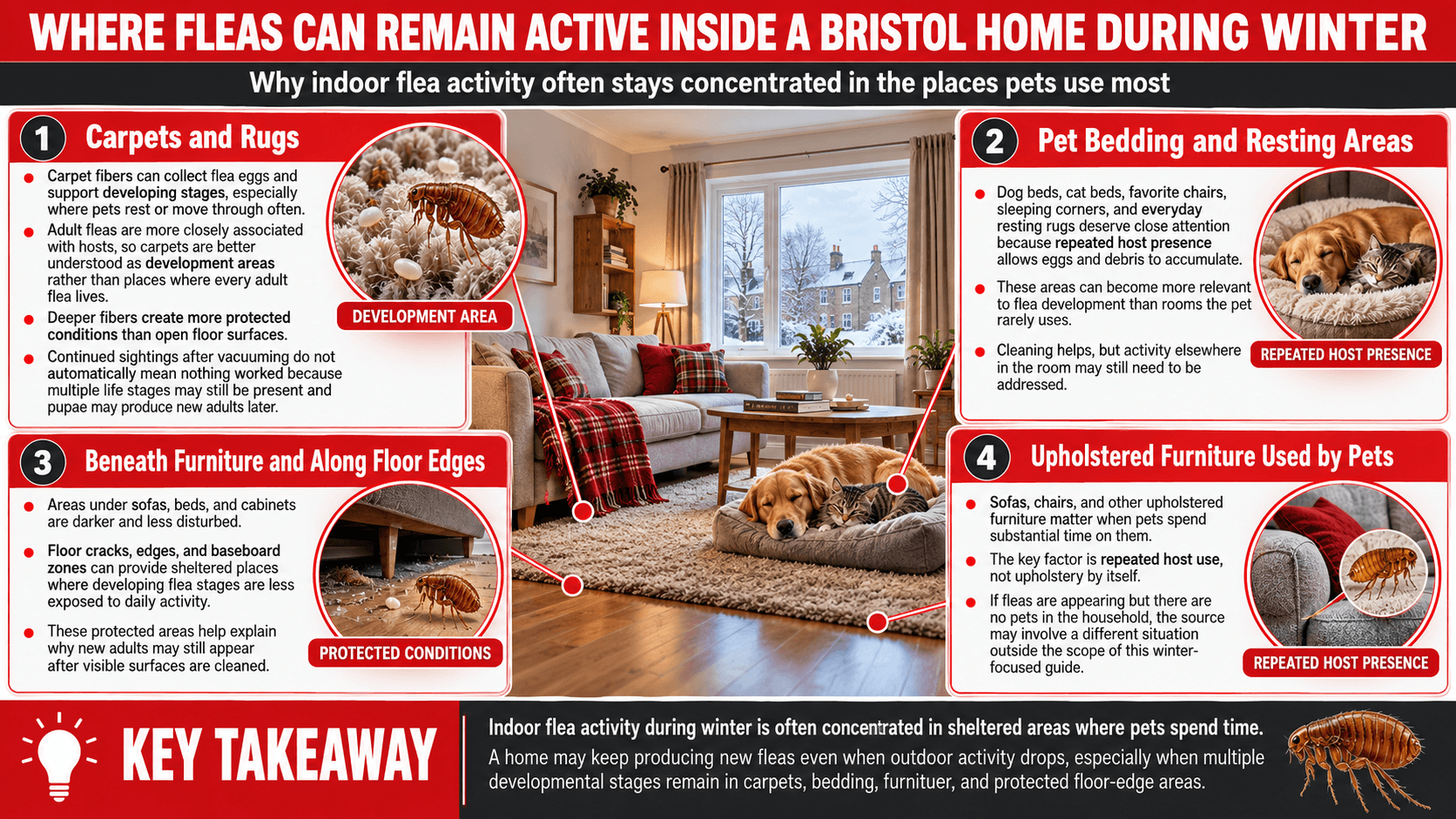
Indoor flea activity is often concentrated around areas where pets spend time rather than spread evenly through every room. Understanding those areas can help explain why fleas continue appearing in specific parts of a house even when outdoor activity has dropped.
Carpets and rugs
Carpet fibers can collect flea eggs and support developing environmental stages, especially in areas where pets regularly lie down or move through the room. Adult fleas are more closely associated with hosts, so it is more accurate to think of carpets as possible developmental areas rather than places where every adult flea permanently lives.
Deeper fibers can also create more protected conditions than an open floor surface. Vacuuming is useful as part of flea management, but continued sightings after vacuuming do not necessarily mean nothing worked. Fleas can be present in several developmental stages, and pupae may continue to produce new adults later.
Pet bedding and resting areas
Pet bedding deserves close attention because it combines repeated host presence with the opportunity for eggs and debris to accumulate. A dog bed, cat bed, favorite chair, sleeping corner, or rug used every day may become a more relevant flea-development area than parts of the home where the pet rarely spends time.
Washing or cleaning these areas can form part of a broader management plan, but activity elsewhere in the room may still need to be addressed. Fleas do not limit themselves to a single bed once environmental stages have been distributed around a property.
Beneath furniture and along floor edges
Areas under sofas, beds, cabinets, and other furniture are often darker and less disturbed than open parts of the floor. Floor cracks, edges, and baseboard areas can also provide sheltered locations where developing flea stages are less exposed to normal household activity.
These protected areas help explain why a home can still produce new adult fleas after obvious surfaces have been cleaned. If the infestation extends into multiple sheltered zones, treatment has to account for more than the places where adults are easiest to see.
Upholstered furniture used by pets
Upholstered chairs, sofas, and other furniture can become relevant when pets spend substantial time on them. The key factor is repeated use by the host, not simply the presence of upholstery in the home.
If fleas are appearing but there are no pets in the household, the source may involve a different situation. Pest Detectives has a separate guide explaining why fleas can appear in a Bristol home with no pets, including sources that are outside the scope of this winter-focused article.
Seeing fleas in December does not mean the infestation started in December
The day you first notice a flea is not necessarily the day the infestation began. Flea activity may have started during late summer or fall when environmental conditions were more favorable, with eggs, larvae, and pupae becoming established indoors before colder weather arrived.
As winter begins, people and pets generally spend more time indoors, and the home remains separated from outdoor freezing temperatures. Some environmental development may continue, while pupae can remain protected before adults emerge later. A homeowner may therefore notice jumping fleas in November or December even though the underlying population began developing weeks earlier.
This seasonal delay is one reason winter flea sightings can feel sudden. The infestation may not have appeared overnight, and the first adult you notice may represent only the visible part of a population that has already passed through several stages inside the home.
Why fleas can seem to come back after you thought they were gone
A drop in the number of visible adult fleas does not necessarily mean every flea stage has been removed. Adults are the stage homeowners usually notice because they jump, bite, and appear on pets. Eggs, larvae, and pupae are much easier to miss.
Pupae are particularly relevant when fleas seem to disappear and then return. A protected pupa can remain in the environment and produce an adult later, making it seem like a new infestation has started. In reality, the new adult may be part of the same flea population that was already present.
Winter does not automatically interrupt this process. If the indoor environment remains protected from outdoor cold, new adults may continue appearing after earlier fleas were removed through vacuuming, cleaning, pet treatment, or other measures. If the household has no pets, see Pest Detectives' guide to fleas in a Bristol home with no pets rather than assuming the source is the same as a typical pet-associated infestation.
Fleas on pets and fleas in the home are two parts of the same problem
A pet with adult fleas and a home containing flea eggs, larvae, or pupae should not be treated as completely separate problems. Adult fleas may spend most of their time on the host, while other stages develop away from the pet in surrounding indoor areas.
Pet flea prevention and medication should be discussed with a veterinarian. A pest-control company does not replace veterinary care and should not be treating fleas on the animal itself.
Pest Detectives focuses on the property and environmental population. That can include carpeted areas, pet-resting zones, floor edges, relevant furniture areas, and other places where flea development may be occurring. Treating the pet while leaving an established environmental population unresolved can allow new adults to keep emerging, while treating the premises without appropriate pet protection can also leave part of the flea cycle in place.
Can indoor-only pets still have fleas in winter?
Yes. Keeping a dog or cat indoors greatly reduces some types of exposure, but indoor-only status does not make fleas impossible. Fleas may already be established in the home, may have been introduced earlier, or may emerge from environmental stages that were present before winter began.
The important point during winter is that an indoor pet lives in the same protected environment as the indoor flea population. If the house remains heated and environmental stages are present, freezing temperatures outside may have little direct effect on fleas already associated with the pet or its resting areas.
If there are no pets in the house at all, the source question becomes different. That topic is covered separately in Pest Detectives' guide to fleas in homes without pets so the winter article can stay focused on seasonal survival and indoor activity.
When winter flea activity means the home needs more than cold weather
Waiting for colder weather makes sense only if cold weather can actually reach the flea population. Once fleas are established inside a heated home, the outdoor forecast may have little effect on environmental stages protected indoors.
Professional flea control may be worth considering when adult fleas repeatedly appear after freezing weather has arrived, pets continue picking up fleas indoors, activity returns after cleaning or vacuuming, several rooms become involved, or flea sightings continue around pet-resting areas. Continued activity after earlier environmental treatment can also indicate that the flea life cycle has not yet been fully interrupted.
Homeowners searching for flea control in Bristol, TN or flea control in Bristol, VA should look for treatment that considers the environmental population rather than focusing only on the adult fleas currently visible. Flea pupae, larvae, eggs, and host-associated adults can all affect how long the problem lasts.
How Pest Detectives handles indoor flea problems in Bristol, TN and Bristol, VA
Pest Detectives begins by looking at where flea activity is occurring and how the pattern is distributed through the property. Sightings around a pet's resting area, one carpeted room, several rooms, or specific pieces of furniture can provide different clues about where environmental stages may be concentrated.
The inspection can include flooring, pet-resting zones, furniture areas, floor edges, cracks, and the rooms where homeowners have reported activity. The goal is to understand the environmental part of the infestation instead of treating every part of the house as though flea activity is identical everywhere.
Professional flea control also has to account for the flea life cycle. Killing the adult flea that happens to be visible does not address every egg, larva, or pupa already present in the property. Newly emerging adults may continue appearing for a period even when earlier visible fleas have been removed, which is why follow-up and an appropriate treatment strategy can matter.
Homeowners can learn more about pest control in Bristol, TN and pest control in Bristol, VA for information about professional treatment of flea activity inside the home.
Frequently asked questions about fleas in winter
Do fleas die in winter?
Cold weather can reduce or kill fleas and developing stages that are directly exposed to unfavorable outdoor conditions for long enough. Fleas inside a heated home or adults living on a warm host are not exposed to the same environment. Winter can therefore reduce outdoor activity without eliminating an indoor infestation.
Can fleas survive inside a heated house during winter?
Yes, fleas can remain active inside a heated house during winter. Warm indoor temperatures can protect them from freezing outdoor conditions, but temperature is not the only factor. Host availability, humidity, carpets, pet-resting areas, and protected microhabitats can also affect survival and development.
Where do fleas go when it gets cold?
Adult fleas may remain on dogs, cats, or other suitable hosts, while environmental stages can be present in carpets, rugs, pet bedding, furniture areas, floor cracks, and other sheltered indoor locations. Fleas outdoors may be more strongly affected by prolonged cold and dry conditions. Their winter survival depends heavily on the environment they are actually occupying.
Does the first freeze kill flea eggs and pupae?
A freeze outside does not automatically kill eggs or pupae located inside a heated home. Exposure matters. Flea stages inside carpets, pet bedding, floor areas, and other protected locations may never experience the freezing temperature recorded outdoors.
Can flea pupae survive indoors during winter?
Flea pupae are enclosed in protective cocoons, and their emergence can be delayed depending on environmental conditions. Pupae already present in a home may therefore produce adult fleas after colder weather has arrived. This is one reason flea activity can seem to return after visible adults temporarily disappear.
Why am I still seeing fleas after several cold nights?
The fleas inside your house may not have been exposed to those cold nights. A heated room, a warm pet, deep carpet fibers, furniture zones, and other sheltered areas can remain far warmer than the outdoor environment. Several nights of freezing weather therefore do not guarantee that an indoor flea population has been eliminated.
Can an indoor cat or dog still get fleas in winter?
Yes. Indoor pets can still have fleas during winter if adults are already on the animal or environmental flea stages are present inside the home. Pet flea prevention and treatment decisions should be discussed with a veterinarian, while environmental flea activity in the property may require separate attention.
Who provides flea control in Bristol, TN and Bristol, VA?
Pest Detectives provides pest-control services for homeowners in Bristol, TN and Bristol, VA, including environmental flea and mite control. The service focuses on identifying where flea activity is concentrated and addressing the indoor flea population rather than relying on winter weather to eliminate the infestation.
Still seeing fleas this winter in Bristol, TN or Bristol, VA?
Cold weather outside does not automatically eliminate fleas that are already established inside a heated home. Adult fleas can remain protected on hosts, while eggs, larvae, and pupae may be present in carpets, pet-resting areas, furniture zones, floor cracks, or other sheltered parts of the property.
If fleas continue appearing indoors after cold or freezing weather has arrived, Pest Detectives can inspect the property, identify where flea activity is concentrated, and recommend an environmental flea-control plan based on what is happening inside the home. Contact Pest Detectives to schedule an inspection in Bristol, TN or Bristol, VA.