
German or American cockroach in your Johnson City home? Compare their size, markings, hiding spots, infestation signs, and when to call for cockroach control.

You turn on the kitchen light late at night and see a small tan cockroach disappear behind the refrigerator. A few days later, another homeowner across Johnson City finds a much larger reddish-brown roach near a basement drain.
Both homeowners have cockroaches, but they may be dealing with two very different species.
German cockroaches and American cockroaches differ in size, appearance, preferred hiding places, behavior, and the conditions that allow them to thrive. Knowing which one is in your home can help determine where the infestation may be coming from and what type of treatment is appropriate.
Pest Detectives provides professional cockroach control services throughout Johnson City and the Tri-Cities and specifically treats German, American, smoky brown, and Oriental cockroach activity. The company's process starts by identifying the species and locating the areas where cockroaches are hiding rather than simply treating the insects that happen to be visible.
German vs. American Cockroach: What’s the Quick Difference?
The easiest difference to notice is size.
German cockroaches are relatively small, usually around 5/8 inch long, with a tan to light-brown body and two dark parallel stripes behind the head. They are especially associated with kitchens, bathrooms, appliances, cabinets, and other indoor areas where food, water, and warmth are available.
American cockroaches are much larger, reaching roughly 1½ inches long. They are reddish-brown and have a pale yellow border around the shield-like area immediately behind the head. They are more commonly associated with damp areas such as crawl spaces, drains, sewer systems, utility areas, and outdoor locations.
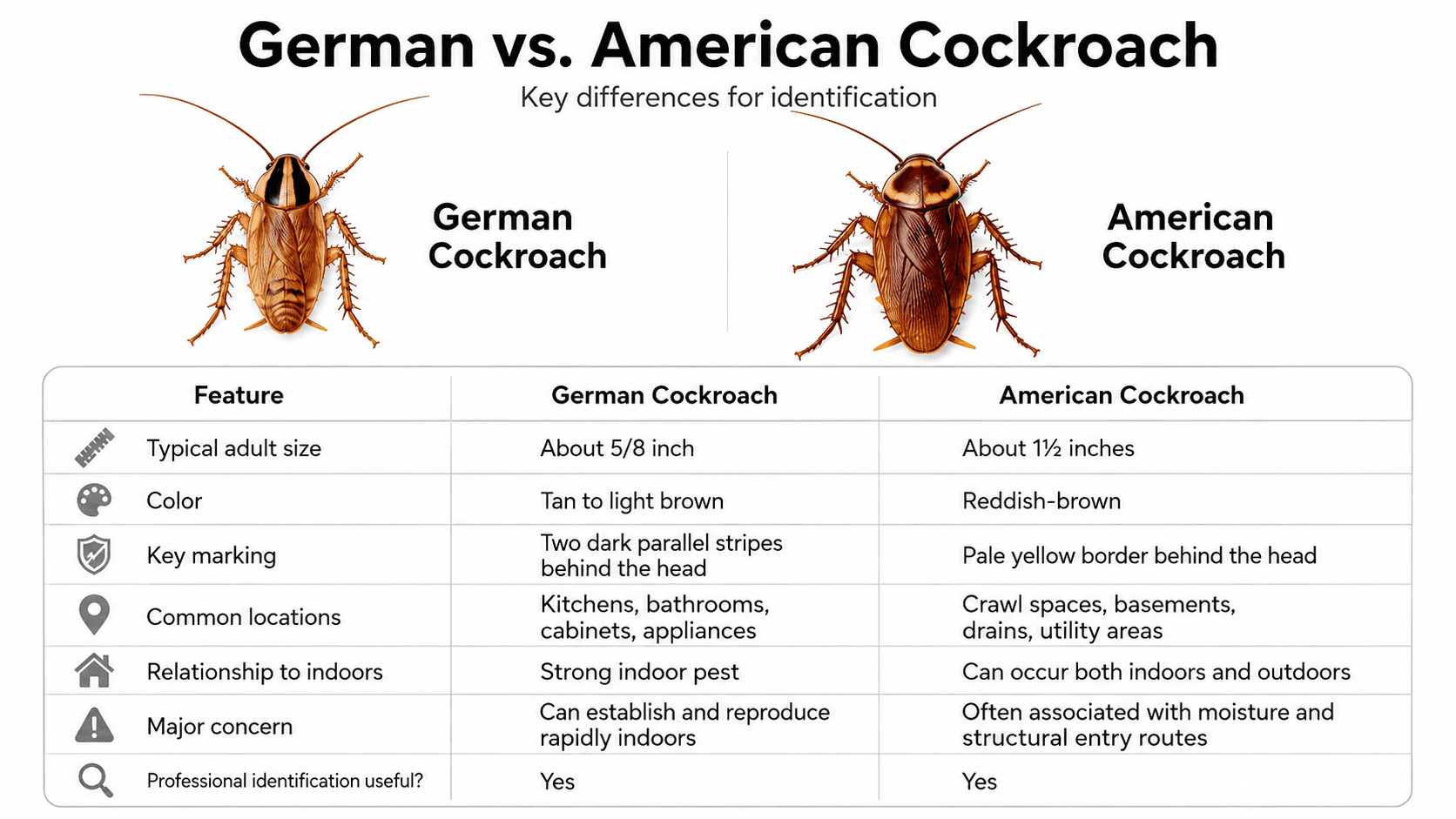
Feature | German Cockroach | American Cockroach |
|---|---|---|
Typical adult size | About 5/8 inch | About 1½ inches |
Color | Tan to light brown | Reddish-brown |
Key marking | Two dark parallel stripes behind the head | Pale yellow border behind the head |
Common locations | Kitchens, bathrooms, cabinets, appliances | Crawl spaces, basements, drains, utility areas |
Relationship to indoors | Strong indoor pest | Can occur both indoors and outdoors |
Major concern | Can establish and reproduce rapidly indoors | Often associated with moisture and structural entry routes |
Professional identification useful? | Yes | Yes |
If you are unsure which species you are seeing, identification should come before treatment. Pest Detectives' Johnson City pest control team specifically identifies pest species and the conditions contributing to activity before building a treatment plan.
How to Identify a German Cockroach
German cockroaches are one of the cockroach species homeowners are most likely to encounter inside buildings.
According to University of Tennessee Extension, German cockroaches are pale brown or tan, approximately 5/8 inch long, and have two parallel dark streaks behind the head. UT Extension identifies them as the most common home-infesting cockroach and notes that they are usually especially abundant in kitchens and bathrooms.
What Does a German Cockroach Look Like?
Look for three main characteristics:
Small size. A German cockroach is considerably smaller than an adult American cockroach.
Light coloring. Adults are generally tan or light brown rather than the darker reddish-brown associated with American cockroaches.
Two dark stripes. The two parallel stripes immediately behind the head are one of the most useful visual clues for identifying an adult German cockroach.
Young German cockroaches, called nymphs, are smaller and darker than the adults, which can sometimes make identification more difficult.
Where Do German Cockroaches Hide?
German cockroaches tend to stay close to reliable sources of food, warmth, and moisture.
In a Johnson City home, that can mean areas such as behind refrigerators, beneath sinks, inside cabinet gaps, around plumbing, near dishwashers, and around warm appliances.
They can fit into very small cracks and spend much of the daytime hidden. That is why a homeowner may not notice significant activity until a light is turned on at night or cockroaches are disturbed while an appliance or cabinet is being moved.
The Pest Detectives cockroach service page similarly identifies cabinet gaps, refrigerators, plumbing areas, kitchens, and bathrooms as common German cockroach harborages.
How to Identify an American Cockroach
American cockroaches are much easier to distinguish by size.
University of Tennessee Extension describes American cockroaches as approximately 1½ inches long, reddish-brown, and marked with a pale yellow band around the area behind the head. They may occur inside homes as well as outdoors, crawl spaces, sewers, water-meter areas, and around garbage.
What Does an American Cockroach Look Like?
Compared with German cockroaches, American cockroaches are:
Much larger. An adult can be more than twice the length of a German cockroach.
Reddish-brown. Their overall color tends to be deeper and darker.
Marked behind the head. Rather than two straight dark stripes, an American cockroach has a contrasting pale yellow border around the shield-like section behind its head.
Adult American cockroaches also have well-developed wings.
Where Are American Cockroaches Usually Found?
American cockroaches are strongly associated with warm, damp environments.
Around homes, that may include basements, crawl spaces, floor drains, utility areas, plumbing systems, garages, and other locations where moisture is present.
Pest Detectives also identifies American cockroaches as a Johnson City pest associated with moisture and notes that its technicians inspect crawl spaces, utility areas, drains, and other potential harborages when determining where activity originates.
German vs. American Cockroaches: 5 Differences Johnson City Homeowners Can Use
While professional identification is useful when an infestation is active, these five differences can give homeowners a good starting point.
1. Size
This is usually the fastest clue. A German cockroach is around 5/8 inch, while an American cockroach can reach approximately 1½ inches.
If the cockroach looks unusually large, American cockroach becomes a more likely possibility. If it is small and repeatedly appearing around kitchen cabinets or appliances, German cockroach activity deserves closer consideration.
2. Color and Markings
German cockroaches are typically tan or light brown with two dark stripes behind the head. American cockroaches are reddish-brown with a pale yellow border around the area behind the head.
Because lighting, age, and distance can make colors difficult to judge, markings should be considered together with size and location rather than used alone.
3. Where You Find Them
Location provides another useful clue.
A small cockroach disappearing underneath a refrigerator or moving through kitchen cabinetry fits common German cockroach behavior.
A large cockroach found near a crawl space, floor drain, basement, or utility room fits the habitat pattern more commonly associated with American cockroaches.
Neither rule is absolute, however. Cockroaches can move beyond their typical harborages, which is why inspection matters.
4. What Their Presence May Tell You
German cockroaches are strongly adapted to living inside buildings. Repeated German cockroach sightings—particularly adults and smaller nymphs in the same area—can indicate an established indoor population.
American cockroaches can also infest structures, but their presence can sometimes point technicians toward moisture conditions, drains, crawl spaces, utility areas, or routes that connect the home to exterior harborages.
The important takeaway is that the same treatment strategy should not automatically be assumed for every cockroach sighting.
5. How Professional Control Differs
Species identification helps determine where a technician should inspect and where treatment should be concentrated.
For German cockroaches, the inspection may focus heavily on kitchens, bathrooms, cabinet voids, appliances, plumbing penetrations, and nearby cracks and crevices.
For American cockroaches, attention may expand toward crawl spaces, drains, basements, utility rooms, moisture problems, and potential exterior access.
Pest Detectives describes its cockroach process as a combination of identification, inspection, targeted treatment, prevention recommendations, and follow-up rather than a one-size-fits-all spray.
Why Cockroaches Are a Problem in Johnson City Homes
Cockroaches are more than an unpleasant sight.
The U.S. Environmental Protection Agency identifies cockroaches as pests of public-health importance because of their relationship with allergies, asthma, and food contamination. Cockroach body parts and droppings contain proteins that can trigger allergic reactions or asthma symptoms in some sensitive individuals.
They are also difficult pests to judge by sightings alone because much of their activity can remain concealed in cracks, cabinets, plumbing voids, appliances, crawl spaces, and other protected areas.
For Johnson City homeowners, that makes proper identification particularly important. The goal should not simply be to kill the cockroach walking across the floor—it should be to determine what species it is, where it is coming from, what conditions are supporting it, and whether additional activity is hidden nearby.
If you're dealing with several different pest issues rather than cockroaches alone, Pest Detectives also offers a wider range of pest control services for homes across Johnson City and the Tri-Cities.
Signs You May Have More Than One Cockroach
One cockroach sighting does not tell you exactly how many are present. Instead of focusing only on the number you have seen, pay attention to the pattern of activity.
Signs that justify a closer inspection include:
repeated nighttime sightings in the same room;
small dark droppings around cabinets or appliances;
egg cases in protected areas;
cockroaches of different sizes, including nymphs;
activity behind refrigerators, stoves, dishwashers, or sinks;
sightings in multiple rooms;
noticeable activity during daylight hours; and
recurring sightings even after food and moisture sources have been addressed.
Pest Detectives' existing guide to the most common household pests in Johnson City also covers general cockroach warning signs and prevention, making it a useful companion resource if you're still trying to determine what type of pest you're seeing.
Does Seeing One Cockroach Mean You Have an Infestation?
Not automatically.
The species, location, time of day, and surrounding evidence all matter.
Finding one large American cockroach near a basement or exterior entry area can represent a different situation from repeatedly finding small German cockroaches of several sizes around a kitchen.
German cockroaches deserve particular attention because they are strongly associated with indoor environments. University Extension sources identify the German cockroach as the most common cockroach pest found inside homes and buildings.
Rather than assuming that one cockroach means either “nothing to worry about” or “a huge infestation,” look for additional evidence and consider a professional inspection when sightings continue.
Why DIY Cockroach Sprays May Not Solve the Source
Seeing a cockroach creates an understandable temptation to reach for the nearest aerosol spray.
The problem is that killing the cockroach you can see does not necessarily tell you where the others are hiding.
Cockroaches can remain deep inside cracks, cabinet voids, plumbing penetrations, appliance areas, crawl spaces, or other locations that a quick surface application does not address. At the same time, food residue, leaks, standing moisture, clutter, and open entry points can continue to support pest activity.
The EPA recommends an integrated approach that includes cleaning food and spills, keeping food in closed containers, reducing clutter, addressing water sources, and sealing cracks and openings.
Professional treatment can then be directed toward the species and harborages actually present.
Pest Detectives says its cockroach control process may use targeted baits, crack-and-crevice applications, growth-regulator strategies, and residual treatments depending on the species and severity of the infestation. Follow-up may also be important, particularly for German cockroach infestations.
When to Call for Cockroach Control in Johnson City, TN
Consider scheduling professional cockroach control when sightings become recurring, you are finding roaches in multiple rooms, different life stages are present, droppings or egg cases appear, or activity continues despite sanitation and prevention efforts.
Professional help is especially useful when you suspect German cockroaches because eliminating what is visible without locating the hidden population may leave the source untouched.
It can also help when large roaches repeatedly appear around basements, crawl spaces, drains, or utility areas, since the inspection can look beyond the room where the insect was found and evaluate possible moisture sources and entry routes.
Pest Detectives provides pest control in Johnson City, TN for homeowners and businesses and lists cockroaches as one of the year-round pest concerns it handles locally.
How Pest Detectives Handles Cockroach Problems
Effective cockroach control begins with understanding which cockroach is present and why it is there.
Identify the Species
Pest Detectives first determines whether the activity involves German, American, smoky brown, Oriental, or another cockroach species. That identification helps guide the rest of the inspection.
Inspect the Property
Technicians look for harborages, activity routes, food sources, moisture conditions, plumbing penetrations, appliance areas, cracks, and other locations associated with the species found.
Build a Targeted Treatment Plan
Treatment is customized according to the infestation and may involve professional baits, targeted crack-and-crevice applications, growth-regulator strategies, and other appropriate measures rather than simply spraying open surfaces.
Address Conditions That Encourage Activity
Homeowners may also receive recommendations for reducing moisture, improving sanitation, storing food properly, and closing potential pest access points.
Follow Up When Necessary
Some cockroach infestations—especially established German cockroach populations—can require monitoring and follow-up to confirm that activity has been brought under control.
Frequently Asked Questions
Which is worse, a German or an American cockroach?
There is no useful universal answer because the two species create different control challenges. German cockroaches are especially problematic when they establish reproducing populations indoors, particularly in kitchens and bathrooms. American cockroaches are much larger and may be associated with damp areas such as crawl spaces, drains, basements, and utility spaces. Correct identification is more useful than deciding which species is “worse.”
Are German cockroaches smaller than American cockroaches?
Yes. German cockroaches are approximately 5/8 inch long, while American cockroaches can reach roughly 1½ inches. Their markings are also different: German cockroaches have two dark parallel stripes behind the head, while American cockroaches have a pale yellow border in the same general area.
Where do German cockroaches hide during the day?
German cockroaches commonly hide in tight, protected spaces close to food and moisture. Typical locations include cabinet gaps, areas behind refrigerators and dishwashers, beneath sinks, around plumbing, and inside cracks or crevices in kitchens and bathrooms. Their nighttime activity is one reason infestations can remain unnoticed at first.
Why am I finding large cockroaches in my basement or crawl space?
Large reddish-brown cockroaches in damp lower areas may be American cockroaches, although visual identification should be confirmed. American cockroaches are commonly associated with crawl spaces, basements, sewers, drains, water-meter areas, and other moist environments. Repeated sightings can justify an inspection for moisture conditions and potential entry routes.
Can German and American cockroaches be in the same home?
Yes, it is possible for more than one cockroach species to occur around the same property because each species may exploit different conditions. A technician may therefore inspect both indoor food/moisture areas and lower or exterior-connected parts of the structure rather than assuming every cockroach has the same source.
Who provides cockroach control in Johnson City, TN?
Pest Detectives provides professional cockroach inspection and treatment for Johnson City and the broader Tri-Cities region. Its cockroach service covers German and American cockroaches as well as other locally encountered species, with treatment based on identification, harborages, infestation severity, and contributing conditions.
Need Cockroach Control in Johnson City, TN?
If cockroaches keep appearing in your kitchen, bathroom, basement, crawl space, or other areas of your home, identifying the species is the first step toward solving the problem.
Pest Detectives serves Johnson City and surrounding Tri-Cities communities with targeted cockroach inspections and treatment plans designed around the pest actually present—not a one-size-fits-all approach.
Request cockroach control from Pest Detectives or call (423) 534-9771 to schedule service.