
Hearing scratching in your Bristol, TN home? Compare rat vs. mouse signs, droppings, noises, gnaw marks, hiding spots, and when to call for rodent control.

It often starts with a sound. You may be lying in bed when you hear scratching behind a wall. Maybe something seems to be moving above the ceiling late at night. A few days later, you notice a chewed food package, small dark droppings near a cabinet, or disturbed insulation in the attic. That usually leads to one question:
Do I have rats or mice?
Rats and mice can leave similar evidence, but there are important differences in their size, droppings, gnaw marks, nesting habits, entry points, and the areas of a home they tend to use. Knowing how to recognize those differences can help Bristol homeowners better understand what may be happening inside their property.
If the evidence keeps returning, professional pest control in Bristol, TN can help identify whether the activity is coming from mice, rats, or another source—and determine where the animals may be getting inside.
Rat vs. Mouse Signs: The Quick Answer
The best way to tell rats and mice apart is to compare several signs together rather than relying on one noise or one dropping. Mice are considerably smaller and typically leave smaller droppings, lighter gnawing damage, and evidence in tight spaces around kitchens, pantries, garages, wall voids, and storage areas.
Rats are much larger. They typically leave larger droppings, can create heavier gnawing damage, and may leave more noticeable travel routes or rub marks. Sounds inside a wall can provide a clue, but sound alone cannot reliably tell you whether the animal is a rat or mouse.
Sign | More Consistent With Mice | More Consistent With Rats |
|---|---|---|
Overall size | Small | Much larger |
Droppings | Small and often rice-like | Larger and thicker |
Gnaw marks | Smaller damage | Heavier, more obvious damage |
Entry openings | Can exploit very small gaps | Generally need larger openings |
Nesting evidence | Shredded paper, fabric, insulation | Larger nests and more material disturbance |
Common indoor areas | Kitchens, pantries, garages, wall voids | Crawl spaces, garages, attics, walls, utility areas |
Sounds | Scratching, rustling, light scurrying | Scratching, gnawing, movement |
Can sound alone identify the pest? | No | No |
The strongest identification usually comes from combining droppings, location, damage, nesting evidence, entry points, and activity patterns.
What Do Mice Sound Like Inside Walls?
Mice are small enough to move through protected spaces homeowners rarely see, including wall voids, areas behind cabinets, spaces around plumbing lines, utility penetrations, and gaps around appliances. When mice are active inside walls, you may hear:
Light scratching
Rustling
Quick scurrying
Occasional gnawing
Movement that seems to travel along a wall or ceiling
These sounds are often easier to notice after dark when the house is quiet. However, a relatively quiet sound does not automatically mean you have mice. Building materials can amplify or soften noises, and plumbing, HVAC equipment, insects, or other animals can sometimes create sounds that homeowners mistake for rodent activity. Instead, look for supporting evidence.
If scratching is accompanied by small droppings, chewed food packaging, nesting material, or small gnaw marks, mouse activity becomes more likely.
Pest Detectives' mice control services are designed to go beyond catching the mouse that happens to be visible. The process includes inspecting areas such as attics, crawl spaces, garages, kitchens, and utility lines for droppings, gnawing, nesting areas, activity zones, and possible entry points.
What Do Rats Sound Like Inside Walls or Attics?
Rats can also travel through concealed parts of a home. Depending on where activity is occurring, homeowners may hear:
Scratching
Gnawing
Movement above a ceiling
Activity inside a wall cavity
Sounds coming from an attic or crawl space
Because rats are larger than mice, their movement may sometimes sound heavier. However, volume should not be used as a reliable way to identify a rodent. A mouse moving across a hollow ceiling can sound surprisingly loud, while a rat moving through insulation may produce relatively little noise.
The location of the activity often provides better information. Movement near an attic or roofline may point an inspector toward different travel routes than evidence concentrated around a lower crawl space, garage, foundation, or utility area. Pest Detectives' rat control services focus on identifying where rats are active, locating entry points and nesting areas, and building a targeted control strategy instead of treating every rodent problem the same way.
Rat vs. Mouse Droppings: One of the Most Useful Clues
Droppings are often one of the first physical signs homeowners find. Although droppings should not be the only evidence used for identification, their size and location can help narrow down whether rats or mice may be present.
What Do Mouse Droppings Look Like?
Mouse droppings are relatively small. They are commonly described as resembling small, dark grains of rice and are substantially smaller than typical rat droppings.
You may discover them:
Inside cabinets
Near pantry shelves
Behind appliances
Inside drawers
Along walls
In garages
Around stored food
Near nesting or travel areas
The pattern matters as well. Several droppings appearing repeatedly along the same wall, cabinet area, or protected route can provide clues about how rodents are moving through the structure.
What Do Rat Droppings Look Like?
Rat droppings are noticeably larger and thicker than mouse droppings. However, not every rat produces identical droppings. Norway rats and roof rats differ in size, behavior, and physical characteristics, so homeowners should avoid assuming that one dropping can provide a perfect species identification.
Location is also important. Larger droppings near a garage, attic, crawl space, utility area, food-storage location, or established travel route may help a pest professional decide where to inspect next.
Be Careful When Cleaning Rodent Droppings
Rodent droppings and contaminated nesting material should be handled carefully. Avoid immediately dry-sweeping or vacuuming significant rodent waste. Disturbing dry contaminated material can put particles into the air.
If you discover substantial rodent evidence in an attic, crawl space, storage room, garage, or other enclosed area, determine the extent of the problem before aggressively disturbing the material.
Compare the Gnaw Marks and Property Damage
Both rats and mice gnaw so this behavior can damage:
Food packaging
Cardboard
Stored belongings
Insulation
Wood
Plastic
Electrical wiring
The scale and location of the damage can provide additional clues.
Signs of Mouse Damage
Mouse activity may leave small gnaw marks around bags of food, cardboard boxes, stored materials, insulation, or openings the animal is attempting to use or enlarge. You may also find shredded paper, insulation, fabric, or other soft material gathered for nesting. As mice can exploit tight spaces, the visible damage may look relatively minor even when activity is occurring inside a protected wall void or another concealed location.
Signs of Rat Damage
Rat gnawing can be more substantial because rats themselves are considerably larger. Homeowners may find damage to:
Stored food containers
Building materials
Wiring
Insulation
Storage boxes
Areas around existing gaps or openings
Repeated chewing around electrical wiring is particularly important to address because the damage may extend into concealed areas of the building. Still, neither the amount of damage nor one tooth mark should be treated as definitive identification. Compare it with the droppings, nesting evidence, activity location, and likely entry routes.
Where Are You Finding the Rodent Signs?
One of the best ways to narrow down a rat-versus-mouse problem is to look at where the evidence is concentrated. A professional inspection considers the entire pattern rather than focusing only on the location where one animal was seen.
Kitchen and Pantry
Kitchens provide food, water, warmth, cabinets, appliances, and many concealed areas. Possible mouse evidence includes:
Small droppings
Chewed food packaging
Shredded nesting material
Activity behind refrigerators
Evidence beneath cabinets
Gnawing near stored foods
Rats can also enter food-storage areas, so the location alone does not prove that mice are responsible.
Walls and Ceilings
Both rats and mice can use concealed structural spaces. Repeated scratching in one portion of a wall may indicate a travel route, nesting area, or nearby access point. Plumbing and electrical penetrations can also allow movement between different concealed sections of the home.
Attics
Attics offer warmth, insulation, nesting material, and relatively little human disturbance. Mice may occupy attic spaces, but rats can also use them. Roof rats in particular are strong climbers and are often associated with elevated structural areas. Look for additional evidence such as:
Droppings
Disturbed insulation
Nesting material
Gnaw marks
Travel paths
Access near rooflines or vents
Crawl Spaces and Basements
Lower structural areas can provide protected rodent routes. Norway rats are commonly associated with lower-level and ground-connected areas, although mice can also use basements and crawl spaces. A proper inspection should evaluate exterior access as well as what is happening inside the structure.
Garages
Garages can provide rodents with food, shelter, nesting material, and easy access to the rest of a home. Attractants may include:
Pet food
Bird seed
Stored food
Cardboard boxes
Clutter
Garbage
Gaps around garage doors
A garage may become a staging point before rodents move farther into the structure.
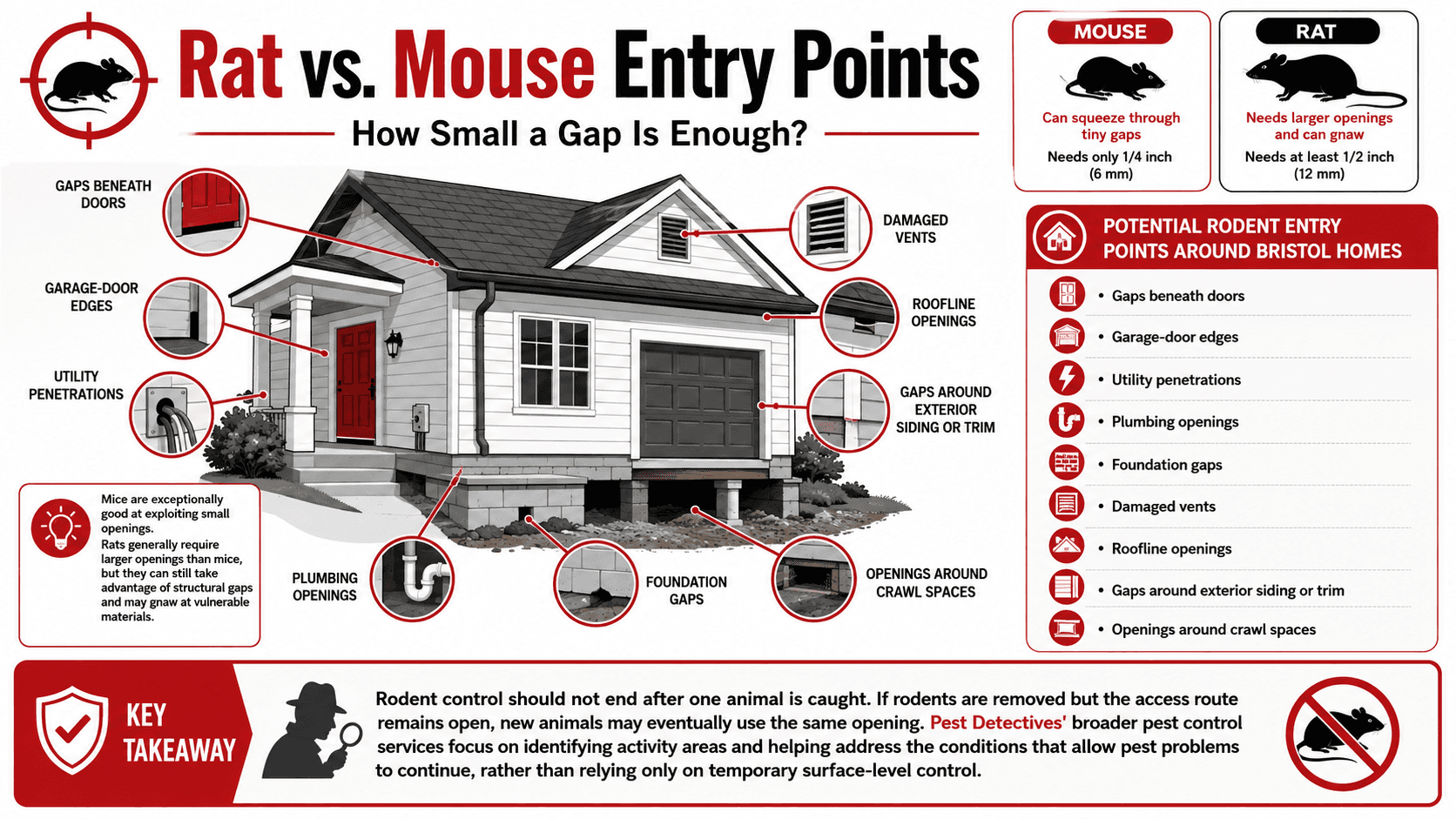
Rat vs. Mouse Entry Points: How Small a Gap Is Enough?
Mice are exceptionally good at exploiting small openings. Potential rodent entry points around Bristol homes can include:
Gaps beneath doors
Garage-door edges
Utility penetrations
Plumbing openings
Foundation gaps
Damaged vents
Roofline openings
Gaps around exterior siding or trim
Openings around crawl spaces
Rats generally require larger openings than mice, but they can still take advantage of structural gaps and may gnaw at vulnerable materials. This is why successful rodent control should not end after one animal is caught. If rodents are removed but the access route remains open, new animals may eventually use the same opening.
Pest Detectives' broader pest control services emphasize identifying activity areas and helping address the conditions that allow pest problems to continue, rather than relying solely on temporary surface-level control.
Which Rats and Mice Can Bristol Homeowners Encounter?
“Rat” and “mouse” are broad terms. Several rodent species can occur in Tennessee, and knowing the species can help guide inspection and control decisions.
House Mice
House mice are among the most common rodents associated with homes and other buildings. They are small, adaptable, and capable of living close to people. Indoors, they may be found around:
Kitchens
Pantries
Garages
Wall voids
Storage areas
Utility spaces
Also, their small body size allows them to use openings that larger rodents cannot.
Deer Mice
Deer mice may be encountered around properties near wooded, rural, or more natural environments. Moreover, their appearance differs from that of a typical house mouse, and identification can be useful when a homeowner assumes that every small rodent is the same species.
Norway Rats
Norway rats are large, robust rodents and activity is more often associated with lower areas and ground-connected environments such as:
Foundations
Garages
Crawl spaces
Exterior burrows
Lower utility areas
Food-storage locations
Roof Rats
Roof rats are more agile climbers and their activity may occur around:
Attics
Upper levels
Rooflines
Overhanging trees
Elevated structural routes
These differences illustrate why professional rodent control starts with identification and inspection, not with assuming that every scratching sound requires the same treatment.
Does Scratching in the Wall Always Mean Rats or Mice?
No. Scratching inside a wall is a reason to investigate, but it is not a diagnosis. Other potential sources of household noises include:
Plumbing
Heating and cooling systems
Normal building movement
Insects
Wildlife
Materials moving because of temperature changes
Rodent activity becomes more likely when sounds occur together with physical evidence such as:
Droppings
Gnaw marks
Damaged food packaging
Nesting material
Unusual odors
Disturbed insulation
Visible entry openings
If several signs are present but the source remains unclear, a professional pest inspection can help determine what type of pest is active and where the problem may be originating.
Signs You May Have an Active Rodent Problem
One unexplained sound is different from repeated physical evidence. Warning signs worth investigating include:
Fresh droppings appearing after an area has been cleaned
Repeated nighttime scratching or scurrying
Chewed food packaging
New gnaw marks
Shredded paper, fabric, or insulation
Greasy or dark rub marks along travel routes
Strong or unusual odors
Damaged insulation
Damaged wiring
Repeated sightings
Evidence appearing in several areas of the home
The more signs that appear together, the stronger the case for a professional rodent inspection.
Why Correct Rat vs. Mouse Identification Matters
If rats and mice behaved exactly the same way, identifying the species would not matter much. However, they do not as many things can differ, such as:
Body size
Travel patterns
Nesting locations
Preferred structural areas
Entry openings
Feeding behavior
Control requirements
Even trap selection and placement may change depending on the rodent and the property. For example, mouse activity concentrated between a kitchen wall and nearby pantry creates a different inspection scenario from a roof rat traveling through an attic or a Norway rat entering around a lower crawl space.
Correct identification helps answer three important questions:
Where is the animal active?
How is it entering the property?
What needs to happen to remove it and reduce the chance of another rodent using the same route?
That is more effective than placing traps randomly near the location where a homeowner happened to hear a sound.
When to Call for Rodent Control in Bristol, TN
One unexplained noise does not necessarily mean your home has a serious rodent infestation. Repeated evidence is different. Consider professional rodent control when:
Droppings continue appearing
Scratching persists over multiple nights
Food packaging is repeatedly damaged
Wiring or insulation has been gnawed
Rodents are seen inside occupied areas
Activity appears in several parts of the structure
You cannot locate the entry point
DIY trapping does not stop the evidence
You are unsure whether the animal is a rat, mouse, or another pest
A professional can evaluate the full pattern rather than making an identification based on a single symptom. For Bristol homeowners dealing specifically with smaller rodent activity, Pest Detectives offers professional mice control and extermination, including inspection, trapping, entry-point evaluation, exclusion recommendations, and follow-up.
For suspected rats, the company's professional rat control service focuses on identifying the type of rat, locating activity and access points, targeted removal, and steps designed to reduce repeat problems.
How Pest Detectives Handles Rats and Mice in Bristol
Pest Detectives uses a multi-step approach because catching one rodent does not necessarily address the reason it entered the property.
1. Identify the Rodent
The first step is determining whether the evidence is consistent with mice, rats, or another source.
Technicians evaluate signs such as:
Droppings
Gnawing
Nesting evidence
Travel routes
Rub marks
Activity locations
2. Inspect the Property
Likely inspection areas may include:
Attics
Crawl spaces
Garages
Kitchens
Utility areas
Exterior foundations
Door gaps
Plumbing penetrations
Roofline openings
The objective is not simply to confirm that a rodent exists. It is to understand how the infestation is functioning within the property.
3. Build a Targeted Control Plan
Control methods depend on the rodent, the location of the activity, the layout of the property, and the extent of the problem. Professional trapping and control devices can then be placed where rodents are actually traveling rather than where they are least likely to encounter them.
4. Address Potential Re-Entry
Rodent removal is only part of long-term control. The property should also be evaluated for conditions that may allow future activity, including vulnerable openings, food sources, clutter, and structural gaps.
5. Follow Up
Continued activity may require adjustments to placements, monitoring, or the control strategy. The goal is not simply to catch one rat or mouse. It is to stop the pattern of activity.
Frequently Asked Questions About Rats and Mice in Bristol, TN
Q.1 How can I tell whether I have a rat or a mouse?
Look at several clues together. Mouse droppings are much smaller, mice can exploit smaller entry points, and their gnawing damage is generally lighter. Rats are substantially larger and typically leave larger droppings and heavier damage. Location, nesting evidence, travel routes, and professional inspection can provide additional confirmation.
Q.2 Are rat droppings bigger than mouse droppings?
Yes. Mouse droppings are relatively small, while rat droppings are considerably larger and thicker. However, different rat species can produce somewhat different droppings, so size should be considered alongside other evidence.
Q.3 Do rats and mice make different sounds inside walls?
They can, but sound is not a reliable identification method by itself. Rats are larger and may sometimes produce heavier movement, but wall cavities, insulation, ceilings, and framing can change how loud an animal sounds.
Q.4 Why do I hear scratching mostly at night?
Rodents are often more active when a home is quiet and human activity decreases. However, nighttime sounds alone do not prove rats or mice are present. Look for droppings, gnawing, food damage, nesting material, or other supporting evidence.
Q.5 Can rats and mice enter through small holes?
Yes. Mice can exploit particularly small openings, while rats can use larger gaps and may gnaw vulnerable materials around potential access points. Doors, garages, foundations, utility penetrations, vents, crawl spaces, and rooflines should all be considered during an inspection.
Q.6 What should I do if I find rat or mouse droppings?
Avoid immediately sweeping or vacuuming dry rodent waste. Significant droppings and nesting materials should be handled carefully, particularly in enclosed spaces such as attics, crawl spaces, garages, or storage areas.
Q.7 Who provides rat and mice control in Bristol, TN?
Pest Detectives provides professional rat and mice control for Bristol and surrounding Tri-Cities communities. Depending on the problem, the process can include inspection, rodent identification, trapping or targeted control, entry-point evaluation, exclusion recommendations, and follow-up.
Need Rat or Mice Control in Bristol, TN?
If scratching sounds, droppings, gnaw marks, damaged food, or other rodent evidence keeps appearing, correctly identifying the animal is an important first step. Pest Detectives helps Bristol homeowners determine what type of rodent is active, where it is traveling, and how it may be getting into the property.
Instead of guessing whether you're dealing with a rat or mouse, have the evidence professionally evaluated and build the control plan around what is actually happening in your home. Contact Pest Detectives or call (423) 534-9771 to schedule rat or mice control service in Bristol, TN and the surrounding Tri-Cities area.