
Not sure whether to choose quarterly or one-time pest control services? Learn which option is better for Johnson City, TN homes and when to call Pest Detectives.

A bug spray gets rid of what you can see today. It does nothing about what's already breeding behind the wall. That's the gap between a one-time pest control service and a quarterly plan, and for Johnson City homeowners, picking the wrong one means paying twice for the same problem.
This guide compares quarterly pest control and one-time pest control services side by side, so you can decide which fits your home, your budget, and the pest pressure that comes with living in Northeast Tennessee.
Key Takeaways
Nationally, 85.2% of residential pest control revenue comes from recurring plans, not one-time visits (NPMA data via Houseler, 2026).
One-time treatments run $100 to $600 per visit; quarterly plans average $100 to $300 per visit but include free re-treatments between scheduled stops.
Two one-time visits in a year typically cost close to, or more than, a full year of quarterly service.
Johnson City's seasonal shifts (spring ants and wasps, fall rodents, year-round termite risk) make single-visit coverage a gap, not a fix.
Quarterly pest control services come with retreatment guarantees that one-time visits rarely include.
What Is a One-Time Pest Control Service?
A one-time pest control service is a single visit aimed at solving the problem you're dealing with right now. A technician inspects your property, identifies the pest, and applies treatment to the affected areas. Most one-time services include a short warranty window, often around 30 days, in case the issue isn't fully resolved on the first pass.
This works well for isolated situations. A single wasp nest under the eaves. A one-off ant trail that showed up after a rainstorm. A spider problem in the garage that's never happened before. If your home rarely sees pest activity and the issue in front of you is contained, a one-time visit solves it without locking you into a recurring agreement.
The limitation shows up afterward. Once the 30-day warranty expires, you're on your own again. If a new pest shows up in August, or the same one comes back in October, that's a brand-new service call at full price.
What Is Quarterly Pest Control?
Quarterly pest control is a recurring service plan, typically four visits a year spaced roughly every three months. The first visit functions like a full treatment: comprehensive interior and exterior inspection, barrier application, and identification of entry points around your foundation, crawl space, and roofline.
The three follow-up visits build on that first treatment rather than starting from scratch. A technician reinforces the barrier, checks bait stations, monitors for new activity, and adjusts based on what's changed since the last visit. Most quarterly plans include a re-service guarantee, meaning if pests show up between scheduled visits, the company comes back at no extra charge.
This is the model most pest control companies recommend for homes that deal with more than one pest issue a year, which describes the majority of homes in Johnson City given the region's seasonal pest cycles.
Quarterly vs One-Time Pest Control: Key Differences
The core difference comes down to posture: one-time service reacts to a problem that's already happened, while quarterly pest control works to prevent the next one. That difference shows up in cost, coverage, and how much you have to think about pests once treatment starts.
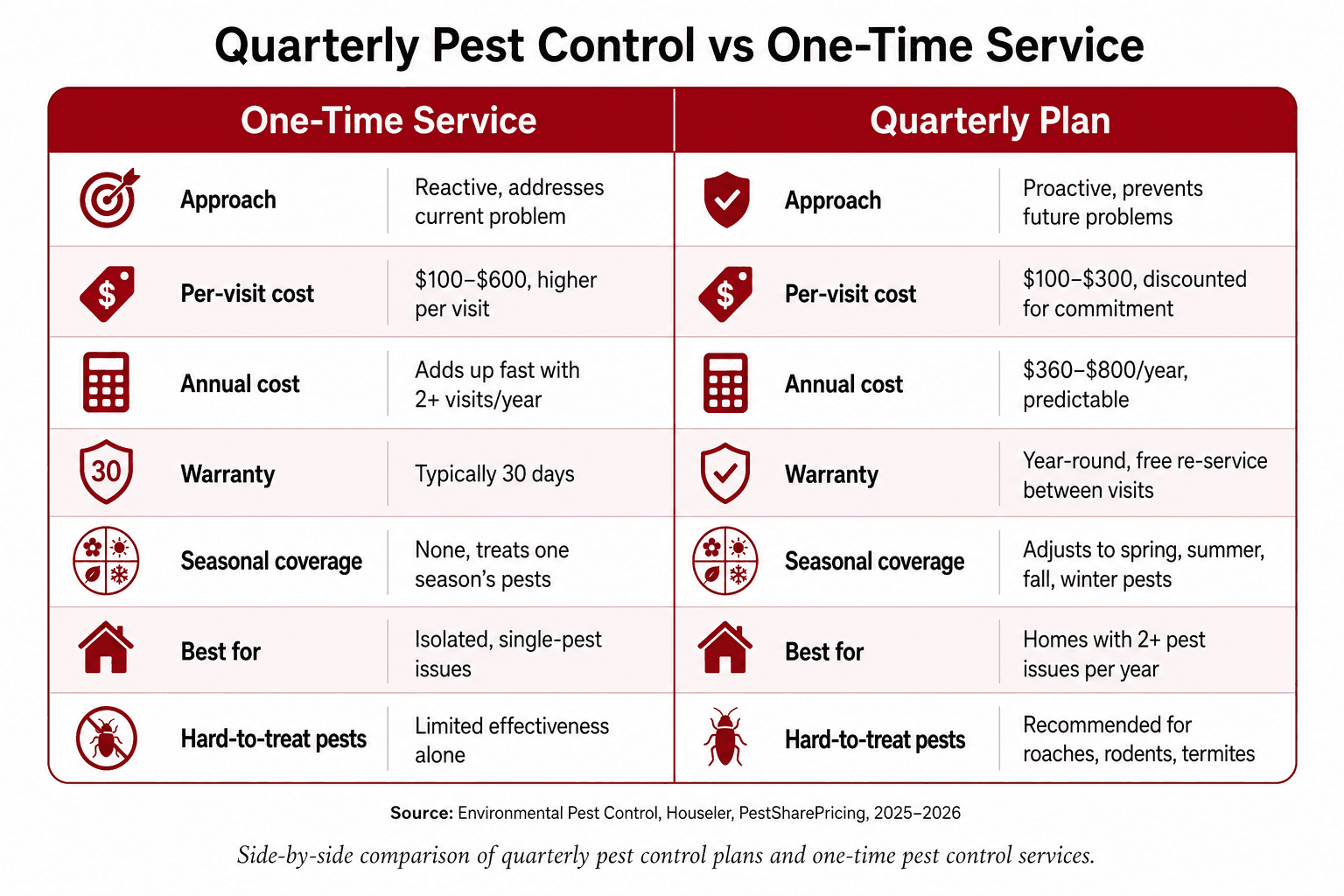
Cost over time. A one-time visit might cost less upfront. But homeowners who end up calling twice in a year, which is common once a pest establishes itself, often spend close to or more than the cost of a full quarterly plan. Industry pricing data shows quarterly plans averaging $360-$800 annually, while two separate one-time visits frequently land in that same range or higher.
Guarantee terms. A one-time service typically protects you for 30 days. A quarterly plan protects you continuously, with most providers offering free callbacks if pests reappear between scheduled visits. That guarantee is one of the main reasons quarterly plans tend to deliver better long-term value.
Pest type. Some pests don't respond well to a single treatment. Cockroaches and rodents reproduce quickly and hide effectively, which means a one-time spray often misses enough of the population to let the problem rebound. Termites and carpenter ants need ongoing monitoring because colony damage isn't always visible right away. These pests are better matched to a recurring plan.
Predictability. Quarterly service means you're not waiting for a problem to surface before calling for help. Each visit catches new activity before it becomes a full infestation, which matters more in a region where pest pressure shifts every few months.
Which Option Is Better for Johnson City Homes?
The right answer depends on what your home actually experiences across the year, and in Johnson City, that's rarely just one pest, one time.
Johnson City's location near the Appalachian foothills, combined with its humid summers and fluctuating seasonal temperatures, creates a pest calendar that repeats every year. Spring and summer bring ants, wasps, and spiders as warmer weather drives insect activity up. Fall sees a sharp rise in rodent activity as mice and rats look for shelter from dropping temperatures. Termites and carpenter ants remain a year-round structural risk thanks to the area's humidity and abundance of wood-frame construction.
Older, historic homes in and around Johnson City often have more entry points: aging weather seals, gaps around foundations, and crawlspace vents that widen over time. Newer construction near developing areas isn't immune either; ground disturbance during building often displaces wasp, hornet, and bee colonies into surrounding properties.
For a home that experiences this kind of seasonal rotation, quarterly pest control is almost always the better fit. You're not paying for one fix and hoping it holds. You're getting a treatment plan that adjusts to whatever the season brings, with a technician who's already familiar with your property and its specific vulnerabilities.
One-time service still makes sense in narrower situations: a newly built home with no history of pest activity, a single contained issue like one wasp nest, or a homeowner who wants to test a provider before committing to a recurring plan. But if your home has seen more than one pest issue in the past year, or if you live near wooded areas, older construction, or a crawl space foundation, quarterly is the option that actually protects the investment you're making.
[UNIQUE INSIGHT] The biggest hidden cost of one-time service isn't the treatment itself, it's the gap between visits. A spring ant treatment with no follow-up leaves your home unprotected when fall rodent season arrives six months later. Quarterly plans close that gap by design, which is part of why providers report the bulk of their revenue now comes from recurring customers rather than single visits.
When to Call Pest Detectives for Pest Control Services
Whether you're dealing with an active problem today or want to get ahead of next season's pests, Pest Detectives provides both one-time and quarterly pest control services in Johnson City, TN. Our local technicians know the specific pest pressures of Northeast Tennessee, from the carpenter ants drawn to moisture-damaged wood to the rodents that move indoors every fall.
Reach out if you're seeing any of the following:
Active ant trails, wasp nests, or spider activity around your home
Signs of rodent activity, including droppings, gnaw marks, or scratching in walls
A history of pest issues that keeps returning season after season
Concerns about termites or carpenter ants near wood structures
A new home purchase and you want a baseline inspection before committing to a plan
We serve homeowners across Johnson City, Kingsport, Jonesborough, and the broader Tri-Cities, with treatment plans built around what your home actually needs rather than a one-size-fits-all schedule.
Schedule a pest control service with Pest Detectives today and find out whether a one-time visit or a quarterly plan fits your home.
Frequently Asked Questions
Q.1 How often should I schedule pest control services in Johnson City, TN?
Most Johnson City homes benefit from quarterly pest control services, roughly every three months, given the area's seasonal shifts between spring ant and wasp activity, summer pest pressure, and fall rodent invasions. Homes that rarely see pest activity, or are dealing with a single isolated issue, may only need a one-time visit. A local inspection from Pest Detectives can confirm which schedule fits your property.
Q.2 Is quarterly pest control better than a one-time treatment?
For most homeowners with recurring or seasonal pest issues, yes. Quarterly pest control plans include free re-treatment between visits, ongoing monitoring, and proactive prevention rather than reactive treatment. Nationally, 85.2% of residential pest control revenue now comes from recurring plans rather than one-time visits, reflecting how often homeowners need ongoing protection rather than a single fix (NPMA data, 2026).
Q.3 When is a one-time pest control service enough?
A one-time pest control service works well for an isolated, contained issue, like a single wasp nest, an occasional ant trail after a storm, or a newer home with no history of pest problems. If the issue is a one-off and your home doesn't typically see seasonal pest pressure, a single treatment with its standard 30-day warranty is often sufficient.
Q.4 What pests are covered by regular pest control services?
Standard residential pest control services typically cover ants, roaches, spiders, occasional invaders, and general perimeter pests. Many quarterly plans also address rodents and provide monitoring for wood-destroying insects like termites and carpenter ants, though termite treatment is sometimes priced as a separate add-on given the specialized inspection it requires. Confirm exact coverage with your provider before signing up.
Q.5 Does quarterly pest control help prevent ants, spiders, roaches, and rodents?
Yes. Quarterly visits maintain a treatment barrier around your home's perimeter and entry points year-round, which interrupts the seasonal cycles that bring ants and spiders in spring and summer and rodents in fall. Because technicians return every three months, new activity gets caught and treated before it develops into a larger infestation, which is harder to achieve with a single annual visit.
Pest Detectives provides residential pest control services in Johnson City, Kingsport, Jonesborough, and across the Tri-Cities region of Northeast Tennessee. Licensed, local, and pet-conscious. Contact us to schedule a free estimate or view current pest control offers.