
Seeing cockroaches in a Johnson City or Kingsport apartment? Learn how cockroaches can move through shared walls, plumbing gaps, utilities, and connected units.

You keep your apartment clean, wipe down the counters, take the trash out regularly, and rarely leave food sitting overnight. Then you find a cockroach under the kitchen sink. A few nights later, another one runs along the wall your apartment shares with the unit next door. Maybe you have even heard that another resident in the building has been dealing with cockroaches.
Can the cockroaches be coming from another apartment? Yes. Cockroaches can move between connected apartment units, and German cockroaches in particular can travel through walls, ceilings, pipes, wires, and other openings inside a building. University of Kentucky Extension also notes that even clean apartments can become infested when cockroaches move through connected multi-unit housing.
But there is an important difference between cockroaches being able to travel between apartments and knowing that the cockroach you found actually came from your neighbor. One sighting beside a shared wall is not enough to identify the source. The cockroach could have moved through the building, but your apartment could also contain its own hidden harborage. It may also have been introduced in a box, appliance, grocery carton, or piece of furniture.
If sightings are becoming frequent, professional cockroach control can help determine whether the activity is concentrated inside your unit or connected to a larger apartment-building problem.
Cockroaches in Johnson City & Kingsport Apartments: Can They Travel Through Shared Walls?
Yes. Apartment buildings give cockroaches more potential travel routes than detached homes because neighboring units can share walls, ceilings, floors, plumbing routes, wiring paths, utility openings, and other concealed spaces.
German cockroaches are particularly relevant in apartments because they live almost entirely indoors and often establish themselves close to food, moisture, and warmth. University of Kentucky Extension notes that they can move between rooms and adjoining apartments through walls, ceilings, pipes, wires, and other openings. NC State Extension also identifies adjoining walls, outlets, and ceilings as possible routes when German cockroaches move or are reintroduced between units.
That does not mean cockroaches normally chew a path through a solid piece of drywall. When residents say cockroaches are coming through the wall, the insects are usually using spaces associated with that wall. These may include a wall void, pipe opening, electrical penetration, cabinet gap, unfinished construction joint, or another small opening that connects a hidden space to the room.
Do cockroaches go through the wall or through openings around it?
A shared wall can look completely solid from inside your apartment while containing a large concealed cavity behind the finished surface. Plumbing lines, electrical cables, outlets, cabinets, and other building components may pass through or connect to this space. Cockroaches do not need to make a new tunnel through intact drywall when existing openings already give them a route.
A cockroach living behind a kitchen cabinet in one apartment may move into a wall void, follow an area containing plumbing or wiring, and emerge through an opening around a pipe or cabinet in another unit. Small gaps behind baseboards and trim can provide additional access points.
This distinction matters when trying to determine where cockroaches are coming from. Spraying the visible section of a shared wall does not necessarily address activity taking place behind cabinets, around plumbing, or inside concealed structural spaces. University of Kentucky Extension specifically recommends sealing openings where pipes and wires pass through walls or floors as one way to reduce cockroach migration between adjoining apartments.
The main routes cockroaches can use between apartment units
Here is the list of the main routes of cockroaches that must require you attention:
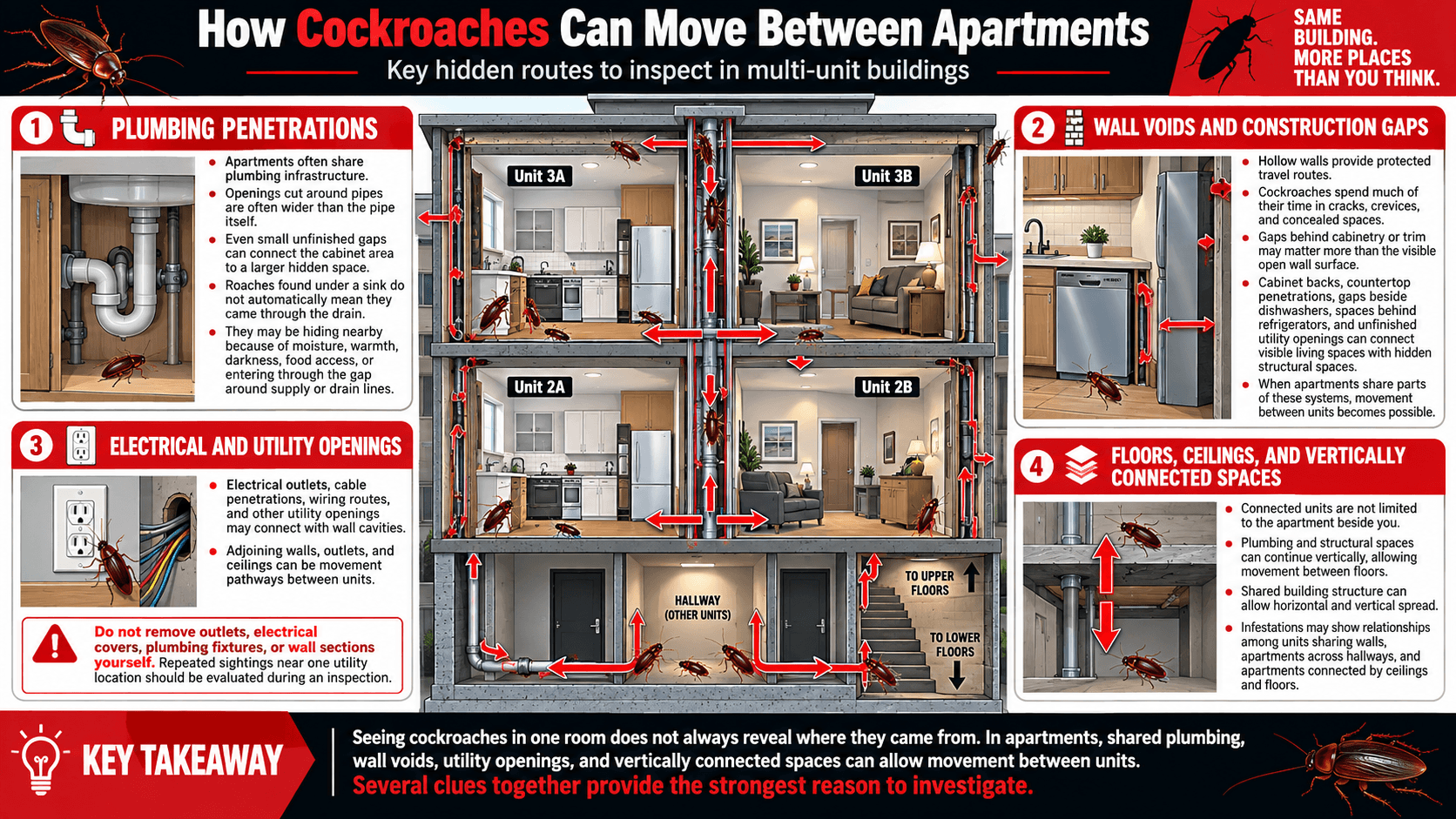
Plumbing penetrations
Kitchens and bathrooms deserve close attention because apartments frequently share plumbing infrastructure. Pipes pass through cabinet backs, walls, floors, and plumbing chases. The opening cut for a pipe is also often wider than the pipe itself. Even a relatively small unfinished gap can connect the visible cabinet area with a much larger hidden space.
This is why finding roaches under the sink does not automatically mean they came through the drain. They may be hiding nearby because the area provides moisture, warmth, darkness, and access to food. They may also be entering through the opening surrounding a supply or drain line instead of traveling inside the water-supply pipe itself.
Wall voids and construction gaps
Hollow walls can provide protected routes between areas of a building. Cockroaches spend much of their time inside cracks, crevices, and other concealed spaces, so a gap behind cabinetry or trim may be more relevant than the large open wall surface a resident sees.
Kitchen installations can create many concealed transitions. Cabinet backs, countertop penetrations, gaps beside dishwashers, spaces behind refrigerators, and unfinished utility openings can all connect visible living areas with hidden structural spaces. When two apartments share parts of these systems, movement between them becomes possible.
Electrical and utility openings
Electrical outlets, cable penetrations, wiring routes, and other utility openings may also connect with wall cavities. NC State Extension lists adjoining walls, outlets, and ceilings among the areas through which German cockroaches may move between units.
Residents should not remove outlets, electrical covers, plumbing fixtures, or sections of wall to look for cockroaches. These areas are better evaluated as part of an inspection, particularly when sightings repeatedly occur around the same utility location.
Floors, ceilings, and vertically connected spaces
The apartment beside you is not the only possible connected unit. Plumbing and structural spaces can continue vertically, giving cockroaches possible routes between floors.
A 2019 Journal of Economic Entomology study examined German cockroach activity in a 188-unit high-rise apartment building. Before the building-wide pest-management program, infestations showed spatial relationships among apartments sharing walls, apartments across hallways, and apartments connected by ceilings and floors. The researchers noted that shared plumbing and building structure could allow movement horizontally and vertically.
Can roaches come from the apartment above or below you?
They can. An apartment directly beside yours is an obvious place to think about because it shares a wall, but apartment buildings also contain vertical connections. Bathrooms and kitchens are especially relevant because plumbing lines may continue through several floors instead of ending at one apartment.
The high-rise study mentioned above found patterns consistent with German cockroach movement between apartments sharing ceilings and floors. That does not mean a downstairs or upstairs unit is automatically responsible whenever you see a cockroach. It means an inspection should not stop with the assumption that the problem must come from whichever apartment shares your living-room wall.
Where the cockroach appears also does not reveal where its journey started. A cockroach seen in your bathroom could have an established harborage inside your own vanity. It could also have moved through a plumbing opening from another connected space or simply wandered from another room in your apartment.
Are they coming through the pipes or through the gaps around them?
Saying that cockroaches are coming through the pipes can describe several different situations, and separating them helps avoid chasing the wrong source.
Some cockroach species can be associated with drains, damp utility areas, sewer systems, or pipe chases. American cockroaches, for example, are more commonly associated with damp locations such as basements, floor drains, sump areas, and pipe chases than German cockroaches. German cockroaches commonly establish themselves in kitchens and bathrooms, including beneath sinks and behind appliances.
In an apartment kitchen, the relevant route may instead be the opening cut around a pipe where it enters the wall or cabinet. University of Kentucky Extension recommends sealing openings around plumbing pipes and wires to reduce movement between adjoining apartments.
There is also a third possibility. The cockroaches may already be harboring inside the sink cabinet or another nearby crack, and the plumbing area simply provides the moisture and shelter they need.
Where you see a cockroach is not always the same place it entered the apartment.
Is your neighbor's apartment actually the source?
Possibly, but there is rarely one observation that proves another apartment is the source. The useful evidence comes from patterns. Look at where activity keeps occurring, whether small nymphs are present, whether egg cases or droppings are found inside your unit, what happens after treatment, and whether other connected apartments are also reporting cockroaches.
What you notice | What it may suggest |
|---|---|
One roach beside a shared wall | Not enough evidence to identify the source |
Repeated activity around shared plumbing penetrations | Movement through connected structural areas becomes more plausible |
Activity returns after conditions and treatment inside your unit improve | Other harborages or connected areas deserve inspection |
Several nearby apartments report cockroaches | Building-level involvement becomes more plausible |
Roaches repeatedly appear around connected kitchen or bathroom systems | Plumbing, wall voids, or utility routes deserve closer inspection |
Nymphs, egg cases, and droppings are found behind your own appliances | Your apartment may contain established activity |
Sightings began after used furniture, appliances, cartons, or boxes arrived | Introduction directly into your apartment is another possibility |
Repeated activity along one plumbing wall is more useful information than a single cockroach crossing the floor. Finding several life stages behind your refrigerator also tells a different story than occasionally finding one adult near an apartment entry point.
Avoid turning the situation into a dispute with a neighboring resident based on one or two sightings. Cockroaches can move through a building, but establishing the source requires inspection and monitoring rather than guessing which resident caused the problem.
Why a clean apartment can still have cockroaches
Cleaning matters because food residue, grease, crumbs, exposed trash, standing water, and clutter can make an apartment much easier for cockroaches to live in. Removing those resources can reduce the conditions supporting an infestation and make other control measures easier.
Cleaning cannot close a pipe penetration inside a cabinet, separate two adjoining wall voids, seal an electrical opening, or disconnect shared building infrastructure. University of Kentucky Extension specifically notes that even clean apartments can become infested because cockroaches can travel between units in multi-unit housing.
A clean apartment with cockroaches is therefore not a contradiction. Sanitation is one part of cockroach management, but apartment residents have limited control over concealed spaces and structural connections beyond their individual unit. Cockroach activity should not automatically be treated as evidence that the resident keeps a dirty home.
Could the cockroaches have started inside your own apartment instead?
Movement between units is only one possible explanation. German cockroaches can also be brought into a home in grocery bags, cartons, furniture, appliances, or other belongings. University of Kentucky Extension identifies grocery bags, beverage cartons, and furniture as possible introduction routes.
Once inside, German cockroaches have plenty of places to establish harborages without ever leaving your apartment. Areas behind refrigerators and stoves, around dishwashers, beneath sinks, inside cabinet gaps, and around plumbing can provide the darkness, warmth, moisture, and nearby food they prefer.
This is another reason not to assume that the unit next door is responsible. An apartment can even have both situations at the same time. It may contain an established population while additional cockroaches move through connected building spaces. Inspection has to consider both possibilities.
What signs suggest cockroaches are established inside your unit?
Repeated sightings from the same kitchen or bathroom area deserve more attention than an isolated cockroach. German cockroaches usually spend daylight hours concealed inside cracks and other dark spaces and become more active at night. Their preferred locations include areas beneath sinks and toilets, behind refrigerators, dishwashers and stoves, and inside cabinets and pantries.
Nymphs can be especially useful evidence because they are immature cockroaches. Finding multiple nymphs, adults, egg cases, droppings, or shed material concentrated behind an appliance or inside a cabinet makes a nearby established harborage more plausible. Pepper-like droppings around cracks and hiding areas can also indicate current or previous activity.
Species matters as well. A small German cockroach repeatedly appearing around a kitchen has different habits from a large American cockroach appearing around a basement or utility area. If you are unsure what you are seeing, Pest Detectives' guide to German vs. American cockroaches covers the size, markings, hiding places, and other differences between the two.
Why cockroaches can return after one apartment is treated
A cockroach reappearing after treatment does not automatically prove that it came from another unit. Hidden harborages may have been missed, activity may remain in difficult-to-reach cracks, or follow-up treatment may still be needed. Food, moisture, and clutter can also continue supporting surviving cockroaches if those conditions remain unchanged.
Connected apartment buildings add another possibility. If cockroach activity extends beyond the apartment where treatment took place, movement from other parts of the building can continue. Research on German cockroaches in multi-unit housing has documented movement between apartments, and the 2019 high-rise study found spatial relationships among connected units before building-wide integrated pest management reduced the building's infestation levels.
University of Minnesota Extension recommends professional attention to adjacent units when dealing with cockroach infestations in multi-unit housing. The exact treatment scope still needs to match what inspection and monitoring show. One complaint does not prove that every apartment in the building is infested.
When cockroach activity involves connected units, treating only the apartment where someone first noticed the problem may not address every source or travel route.
Does the whole apartment building need treatment?
Not automatically. The appropriate response depends on the species involved, where cockroaches are being detected, the amount of activity, evidence in connected apartments, building layout, and what monitoring shows over time.
A problem concentrated behind one refrigerator does not necessarily call for the same response as recurring German cockroach activity across several apartments sharing kitchen plumbing. A resident spotting one large cockroach also does not establish that every surrounding unit has an infestation.
Adjacent-unit inspection becomes more relevant when activity repeatedly returns, several connected units report similar problems, or monitoring suggests cockroaches are moving through shared areas. The treatment area should follow the evidence. Neither the smallest possible treatment area nor the entire building should be assumed to be correct before inspection.
What should you document before a cockroach inspection?
A useful record tells an inspector much more than saying that you keep seeing cockroaches. Note the date and approximate time of each sighting, the exact room, and where the cockroach was in relation to a sink, cabinet, appliance, baseboard, utility opening, or shared wall.
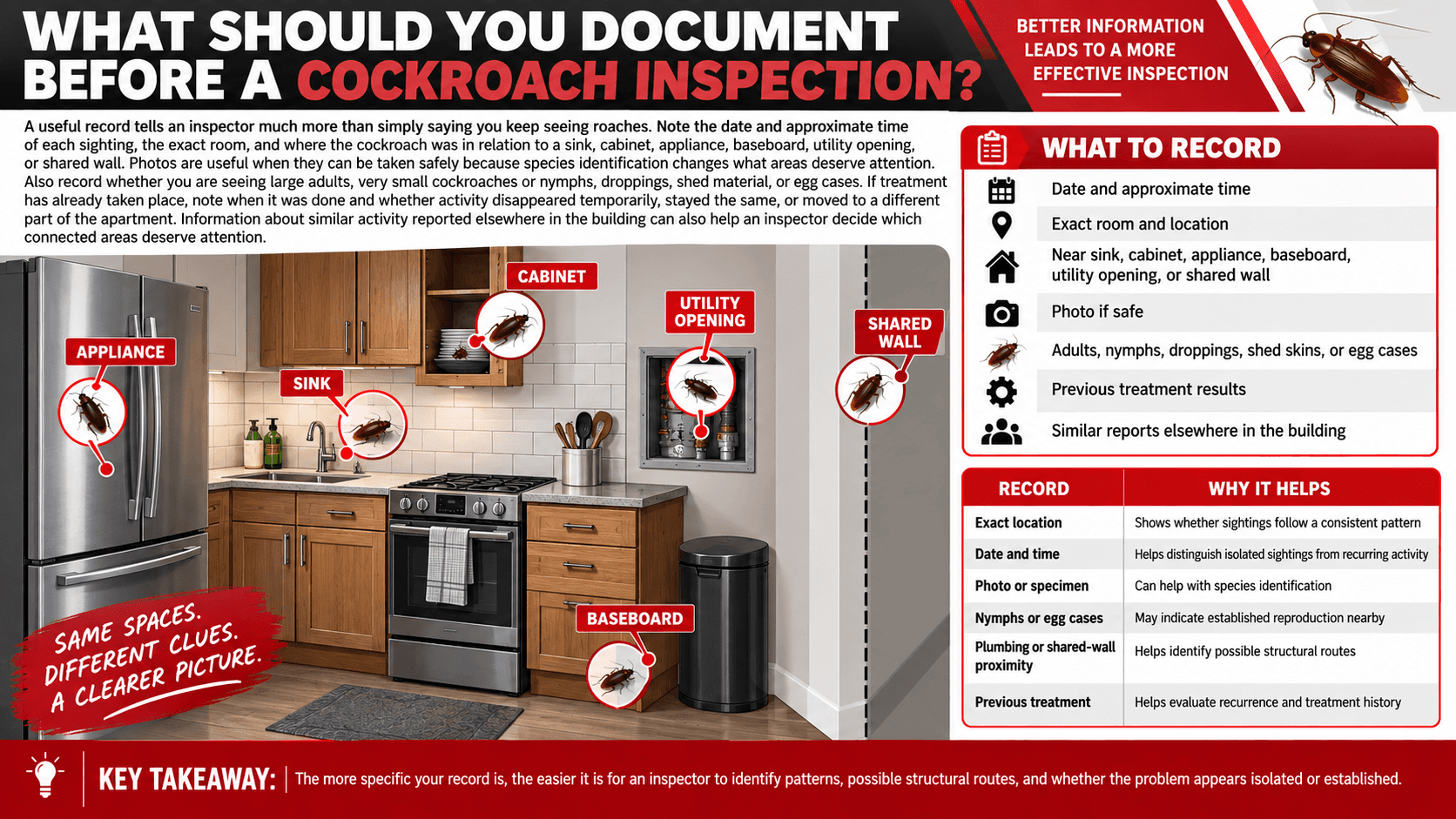
Photos are useful when they can be taken safely because species identification changes what areas deserve attention. Also record whether you are seeing large adults, very small cockroaches or nymphs, droppings, shed material, or egg cases.
If treatment has already taken place, note when it was done and whether activity disappeared temporarily, stayed the same, or moved to a different part of the apartment. Information about similar activity reported elsewhere in the building can also help an inspector decide which connected areas deserve attention.
Record | Why it helps |
|---|---|
Exact location | Shows whether sightings follow a consistent pattern |
Date and time | Helps distinguish isolated sightings from recurring activity |
Photo or specimen | Can help with species identification |
Nymphs or egg cases | May indicate established reproduction nearby |
Plumbing or shared-wall proximity | Helps identify possible structural routes |
Previous treatment | Helps evaluate recurrence and treatment history |
What apartment residents can do without guessing at the source
Start with the conditions you can actually control. Clean food residue and grease, store food in sealed containers, avoid leaving pet food exposed overnight, empty trash regularly, reduce unnecessary cardboard and clutter, and correct accessible moisture problems such as small leaks when you are responsible for them. These steps remove resources cockroaches use, even when they are not the original source of the problem.
Keep documenting where sightings occur instead of spraying every area where a cockroach happens to run. Report recurring activity through the appropriate property contact when needed, especially if you suspect a structural issue or shared area that you cannot access yourself.
Avoid taking apart electrical outlets, opening walls, dismantling plumbing, or pulling apart building components to search for cockroaches. Indiscriminate spraying can also make it harder to manage an infestation effectively and may interfere with other treatment methods. The goal is to collect useful evidence and reduce favorable conditions, not to prove on your own which apartment the cockroaches came from.
When to call for cockroach control in Johnson City or Kingsport
Professional inspection becomes more useful when sightings continue over several days or weeks, nymphs or egg cases start appearing, activity returns after previous treatment, or cockroaches repeatedly show up around shared plumbing and wall areas. It is also worth having the situation inspected when several apartments may be involved or you cannot determine whether the insects are established inside your unit or moving in from elsewhere.
Residents looking for pest control in Johnson City, TN can have the species, harborages, and likely travel areas inspected instead of relying only on the location of the latest sighting. Pest Detectives lists cockroach treatment among the services available to Johnson City homes and businesses.
The same source-diagnosis approach matters for residents seeking pest control in Kingsport, TN, particularly in apartments and other properties where plumbing, walls, ceilings, and utility spaces connect multiple occupied areas.
How Pest Detectives approaches cockroach problems in apartments
Cockroach control starts with determining what species is present and where the insects are spending their time. Pest Detectives' current cockroach-control process includes inspecting areas such as appliances, cabinet voids, and plumbing penetrations and looking at the food and moisture conditions associated with the activity. That matters in an apartment because the place where a resident sees the cockroach may be several feet away from its harborage or separated from it by a concealed space.
The next question is whether the activity appears localized or connected. Repeated sightings near plumbing, utility transitions, cabinet openings, or other shared systems can justify looking beyond the immediate room. Monitoring and physical evidence are more useful here than assuming either that the neighbor is responsible or that every cockroach must have originated inside your apartment.
Treatment can then be matched to the species and severity. Pest Detectives says its cockroach plans may include gel baits, insect growth regulator strategies, crack-and-crevice applications, and targeted residual treatments. Its service page also describes follow-up and monitoring as part of cockroach treatment, particularly for German cockroach infestations.
Residents and property managers dealing with repeated activity can review Pest Detectives Cockroach Control services for more information about inspection and treatment options in the Tri-Cities.
Frequently asked questions about cockroaches moving between apartments
Q.1 Can cockroaches really travel between apartments?
Yes. German cockroaches can move between adjoining apartments through connected walls, ceilings, plumbing areas, wiring routes, outlets, and other structural openings. The possibility of movement does not by itself identify which apartment an individual cockroach came from.
Q.2 Can roaches come through a shared wall?
They can move through spaces associated with a shared wall, especially wall voids and openings around pipes, wiring, cabinets, outlets, trim, and other penetrations. Saying that a roach came through the wall does not usually mean it chewed directly through intact drywall.
Q.3 Can roaches come from the apartment above or below?
Yes. Floors and ceilings can contain connected structural and plumbing routes, and research in a high-rise apartment building found spatial relationships between German cockroach infestations in vertically connected units. A sighting alone still cannot tell you whether the source was upstairs, downstairs, next door, or within your own apartment.
Q.4 Can cockroaches travel through plumbing?
Plumbing areas can provide routes, but the distinction matters. In many situations, the relevant path is the opening around a pipe or a shared plumbing chase rather than the inside of the water-supply pipe itself. A cockroach under the sink may also be harboring locally.
Q.5 Can cockroaches come through electrical outlets?
German cockroaches can use connected wall and utility spaces, and NC State Extension includes outlets among the possible movement points in multi-unit settings. Do not dismantle an electrical outlet to investigate cockroach activity yourself.
Q.6 Why do I have roaches if my apartment is clean?
Cleaning reduces food, grease, water, and clutter that can support cockroaches, but it cannot isolate your apartment from every connected wall, ceiling, plumbing, or utility space. University of Kentucky Extension notes that even clean homes can become infested in multi-unit housing where cockroaches travel between units.
Q.7 How do I know if the cockroaches are coming from another unit?
There is no single sign that proves it. Repeated activity near connected plumbing or utility openings, similar reports from nearby apartments, and recurrence after conditions inside your unit have been addressed can make movement between units more plausible. Nymphs, egg cases, droppings, and concentrated activity behind your own appliances may show that your unit also contains established harborages.
Q.8 Who provides cockroach control in Johnson City and Kingsport?
Pest Detectives provides cockroach-control services in Johnson City, Kingsport, and other communities across the Tri-Cities. Its process includes species identification, inspection of harborages and travel routes, targeted treatment, prevention recommendations, and follow-up when needed.
Cockroaches keep appearing in your Johnson City or Kingsport apartment?
If cockroaches continue appearing around shared walls, plumbing, kitchen cabinets, appliances, or other connected areas, the source may not be obvious from the room where you found them. Repeated activity can involve a harborage inside the apartment, movement through connected building spaces, or both. Identifying the species and inspecting the surrounding areas can help determine what is actually happening before deciding what needs treatment.
Pest Detectives provides cockroach inspections and treatment across Johnson City, Kingsport, and the surrounding Tri-Cities. The team can inspect likely harborages and travel routes, determine how widespread the activity appears to be, and build a treatment plan around the evidence found at the property. If cockroaches keep returning or you cannot identify where they are coming from, contact Pest Detectives to schedule an inspection.