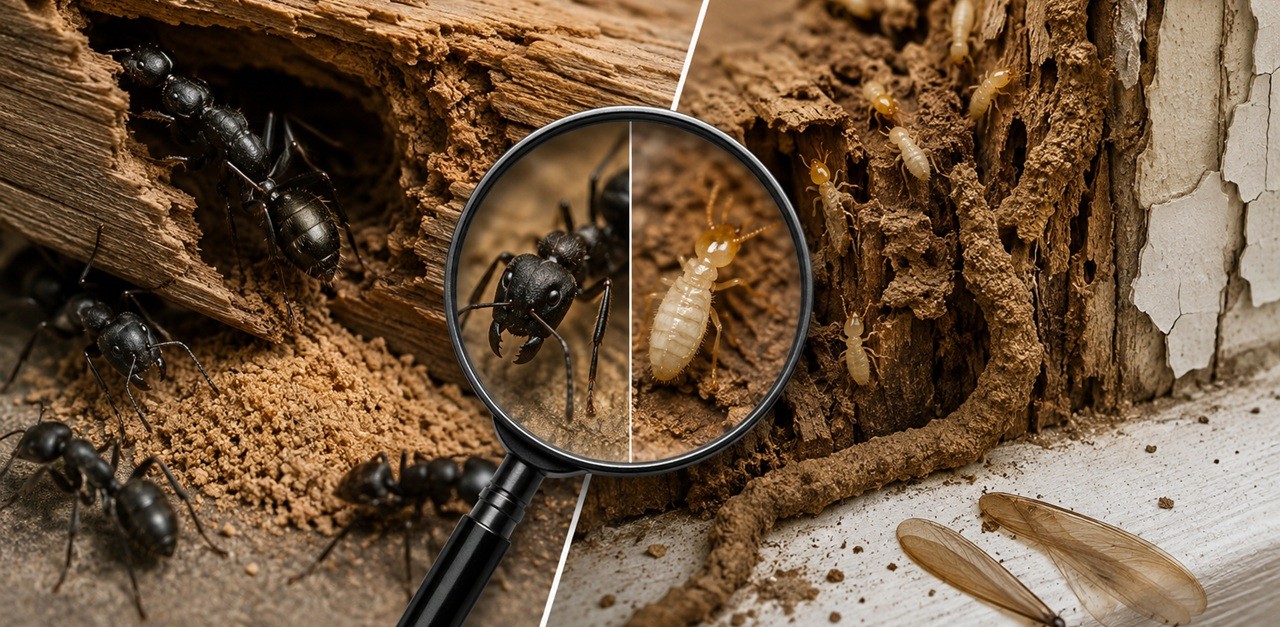
Not sure if you have carpenter ants or termites in your Kingsport home? Learn the key signs, damage differences, and when to call Pest Detectives for ant control or termite treatment in Kingsport, Johnson City, and Bristol, TN.

Sawdust near a baseboard. A wing on the windowsill. A soft spot in the floor you didn't notice last month. These details matter, and they point to two very different problems: carpenter ants or termites. Getting the identification wrong means getting the treatment wrong, and in Kingsport, TN, that mistake costs money.
This guide breaks down exactly how to tell carpenter ants and termites apart, what each pest does to your home, and when to call for ant control in Kingsport, TN or termite treatment in Kingsport, TN before the damage gets worse.
Key Takeaways
Termites cause an estimated $5 billion in property damage across the U.S. every year, affecting roughly 600,000 homes annually (Orkin, 2025).
Kingsport's warm, humid summers and proximity to lakes create ideal conditions for both pests.
Carpenter ants carve smooth, clean galleries in wood. Termites leave rough, mud-caked tunnels.
Both pests are drawn to moisture-damaged wood, so a pest problem often signals a water problem too.
DIY sprays kill the ants you see but rarely reach the colony behind your wall.
Why Kingsport Homes Attract Carpenter Ants and Termites
Kingsport's climate does two things well: warm summers with long humid stretches, and mild winters that don't kill off pest colonies the way colder regions do. Add nearby lakes and rivers to that picture, and you have elevated ambient moisture year-round.
Both carpenter ants and termites depend on moisture. Carpenter ants won't nest in sound, dry wood. They look for wood that's already soft from a leak, poor drainage, or a busted gutter. Eastern subterranean termites, the species most common in Tennessee, become active once soil temperatures climb above 50°F, which happens for eight to ten months of the year in this part of the state (Tennessee Pest Authority).
Older homes in the Tri-Cities area compound the risk. Crawl space foundations expose structural lumber close to soil level. Pier-and-beam construction leaves wood within easy reach of foraging termites moving up through mud tubes. If your home has a crawl space that runs humid in summer, both pests treat it as an open invitation.
That's why pest problems in Kingsport aren't bad luck. They're predictable, and they're preventable with the right inspection at the right time.
Carpenter Ants vs Termites: The Quick Difference
Termites eat wood. Carpenter ants hollow it out for nesting but don't consume it. That single behavioral difference drives nearly every other distinction between the two pests, from the damage they leave to the treatment required to eliminate them.
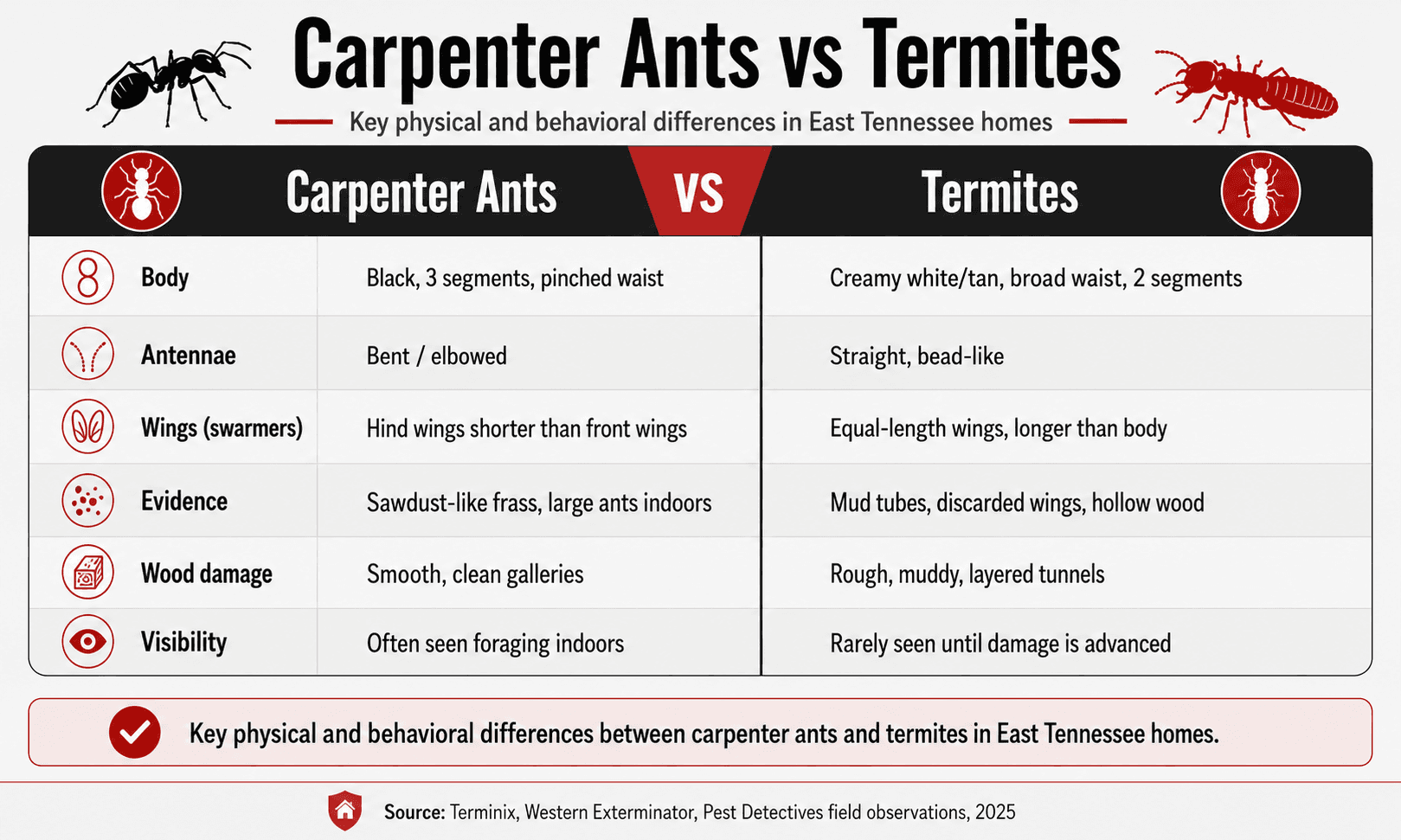
What you'll see with carpenter ants: Large black ants, sometimes three-quarters of an inch long, foraging along baseboards or kitchen counters. Piles of sawdust-like material near wooden beams, door frames, or windowsills. Faint rustling or crunching sounds from inside walls at night.
What you'll see with termites: Mud tubes running up foundation walls or across joists. Discarded wings clustered near windows or light sources, left behind by reproductive swarmers. Wood that sounds hollow when you tap it. Bubbling or peeling paint that looks like water damage but isn't.
The practical test: if you're seeing large black ants indoors, you're probably dealing with carpenter ants. If you're finding wings and mud but no ants, think termites.
[CITATION CAPSULE] Eastern Subterranean Termites become active when soil temperatures exceed 50°F at 12-inch depth. Tennessee's climate produces this threshold across most of the state for 8 to 10 months per year, making termite risk a near year-round concern for Kingsport homeowners. (Tennessee Pest Authority)
Signs You May Need Ant Control in Kingsport, TN
Carpenter ants don't show up randomly. They follow moisture and damaged wood, which means a carpenter ant problem almost always points to a secondary problem somewhere in your home. Watch for these signs:
Sawdust that wasn't there before. Carpenter ants push excavated wood material out of their galleries. You'll find small piles near baseboards, under sinks, at the base of window frames, or beneath decks. It looks like fine sawdust but may contain insect parts.
Large black ants inside, especially at night. Worker carpenter ants forage away from the nest, which is why you spot them in kitchens and bathrooms. Seeing them regularly indoors suggests a nest is established nearby, often within your home's wood structure.
Sounds inside the walls. A faint crackling or rustling from inside a wall at night can mean a carpenter ant colony is active. The workers are moving through tunnels they've carved in the wood.
Soft spots in wood or sagging structures. Carpenter ants prefer damp wood. If a beam, joist, or floor section has gone soft, ants may already be nesting inside it, or the moisture that attracted them is doing damage of its own.
Ants near windows and exterior doors in spring. When temperatures rise, satellite colonies send workers out to establish new nesting sites. Finding clusters of ants near entry points in spring often means the main nest is in a tree or wood pile outside, with satellite activity starting inside your walls.
If you see any of these signs, contact Pest Detectives for ant control in Kingsport, TN. A professional inspection finds the nest. Spraying the ants you can see only removes the visible workers, not the colony producing them.
Signs You May Need Termite Treatment in Kingsport, TN
Termites are harder to spot than carpenter ants, and that's what makes them more expensive. By the time most homeowners notice visible termite damage, a colony has been active for months or years. Know what to look for:
Mud tubes on the foundation. This is the clearest sign of subterranean termites. Workers build pencil-width tubes from soil up the side of your foundation to reach wood above. You'll find them on exterior walls, in crawl spaces, and across floor joists. Break one open: if it's active, workers will be inside.
Discarded wings near windows or sliding doors. Termite swarmers, the reproductive members of a mature colony, emerge in late winter through spring in East Tennessee. They shed their wings after finding a mate. Finding a cluster of equal-length wings near a light source or door frame is a red flag.
Wood that sounds hollow. Tap wooden door frames, baseboards, or structural beams. Solid wood makes a firm sound. Wood that's been eaten through from the inside sounds dull and hollow.
Bubbling or uneven paint. Termites generate moisture as they work, which can cause paint to bubble, warp, or peel in a pattern that mimics water damage. If you can't find a leak but the paint looks like you have one, have a professional check for termites.
Sagging floors or doors that don't close properly. Severe termite damage compromises the structure that holds your floors and frames square. If a floor section sags or a door suddenly binds where it didn't before, don't assume it's settling.
Termite colonies typically take three to five years to grow large enough to cause visible damage (Orkin). That means by the time you see these signs, treatment is overdue. Schedule termite treatment in Kingsport, TN with Pest Detectives at the first warning sign.
[CITATION CAPSULE] Termites damage roughly 600,000 homes in the U.S. annually. The average homeowner who discovers termite damage spends around $3,000 on repairs, and structural damage from a severe infestation can run from $10,000 to over $37,500 (Orkin; Angi, 2025). Homeowners insurance typically does not cover termite damage.
Carpenter Ant Damage vs Termite Damage
Both pests attack wood. The damage they leave looks different, and understanding that difference helps you describe what you're seeing when you call for an inspection.
[ORIGINAL DATA: Field observation patterns documented by Pest Detectives technicians across Kingsport, Johnson City, and Bristol service calls, 2024-2025]
Carpenter ant galleries are clean and smooth, almost finished-looking. The ants remove wood debris rather than pack it back in, so the tunnels have a sanded quality to them. You may see chambers where the colony rests or raises young. The damage is real, but it progresses slowly compared to termites.
Termite tunnels are rough, muddy, and packed with soil particles and fecal matter. Workers use mud to plaster the inside of their galleries, which protects them from the open air. When you open a piece of termite-damaged wood, you're likely to find a dark, layered honeycomb of tunnels filled with debris.
Speed matters here. Termite wood damage can become substantial within two to four years of an established colony. A mature subterranean termite colony can number up to a million workers, all consuming wood continuously. Carpenter ant colonies typically number in the thousands, and since they're excavating rather than eating, the damage rate is slower.
That said, slow doesn't mean harmless. A carpenter ant colony that's been in your wall for five years can hollow out structural lumber to the point of failure, especially if moisture has been weakening the wood simultaneously.
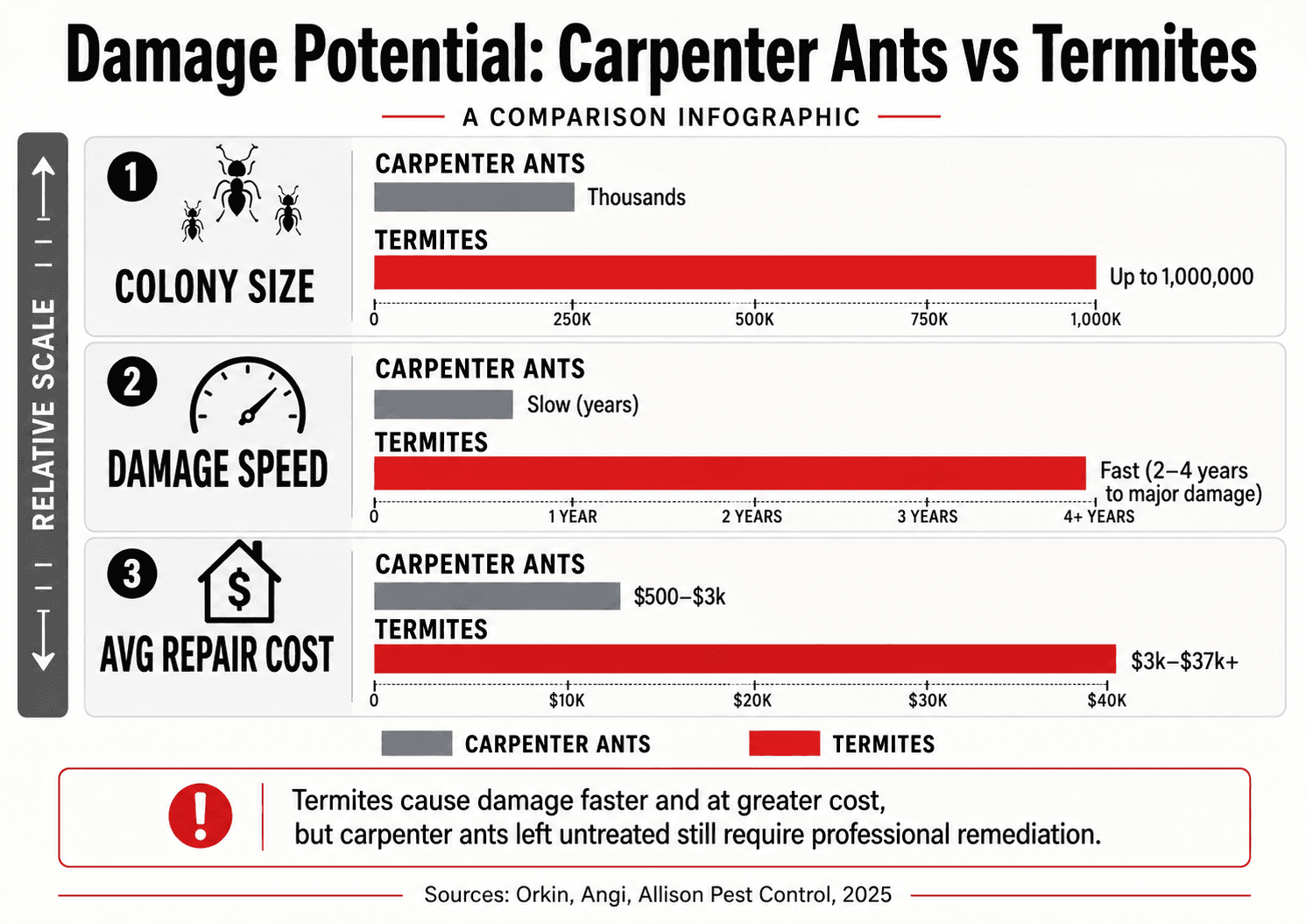
The bottom line on damage: termites are the greater financial threat. But a carpenter ant infestation that goes unchecked for years, especially in a home with existing moisture issues, can cause structural damage that runs into thousands of dollars to repair.
Can You Treat Carpenter Ants or Termites Yourself?
Homeowners try. Most don't succeed, and here's why.
For carpenter ants: Store-bought sprays kill worker ants on contact. The problem is that workers represent a small fraction of the colony. The queen, and the satellite nesting sites she supports, stay hidden in wall voids, behind insulation, or inside structural beams. Once the spray dissipates, the colony sends out fresh workers. You eliminate the symptom repeatedly while the source keeps producing.
Professional ant treatment targets the nesting sites directly, using baits and treatments that workers carry back to the colony. A technician also looks for the moisture problem that attracted the ants, which a spray from a hardware store will never address.
For termites: This is where DIY attempts become genuinely risky. Termite colonies operate underground or inside walls. Consumer termiticide products can't reach the colony structure. Liquid barrier treatments require specialized equipment to apply correctly, and even a small gap in coverage leaves the colony active.
Misidentifying the colony type makes things worse. Eastern subterranean termites require different treatment approaches than drywood species. Treating for the wrong type wastes time while the actual colony keeps eating.
Both pests require a professional inspection first, not because pest companies want the business, but because the nest location determines the treatment. Spraying what you can see is not the same as treating the source.
[UNIQUE INSIGHT] Carpenter ants found inside a home in winter are a stronger warning sign than summer sightings. During cold months, the outdoor colony goes dormant. Indoor ant activity in January or February means the nest itself is inside your home's warm walls, not in a yard tree or woodpile. That colony is protected year-round and will grow until treated.
Ant and Termite Help in Kingsport, Johnson City, and Bristol
Pest Detectives serves homeowners across the Tri-Cities region. Whether you need ant control in Kingsport, TN, ant control in Johnson City, TN, or ant control in Bristol, TN, the first step is a professional inspection to confirm exactly what pest you're dealing with.
The company also provides comprehensive termite inspection and treatment for homeowners seeking termite treatment in Kingsport, TN, termite treatment in Johnson City, TN, and termite treatment in Bristol, TN. Every Tri-Cities home faces similar climate pressures: the warm, humid summers, the crawl spaces that hold moisture, the older wood-frame construction that gives both pests entry points.
An inspection from Pest Detectives identifies not just the pest but the conditions that invited it. Fixing a carpenter ant problem without addressing the underlying moisture issue means the ants, or a different pest, will return.
When to Call Pest Detectives
Don't wait for damage to become obvious. By that point, repairs are already expensive. Call when you see any of the following:
Large black ants inside, especially at night or in winter
Sawdust-like piles near wood structures or along baseboards
Mud tubes on your foundation or in your crawl space
Discarded wings near windows or exterior doors
Wood that sounds hollow when you tap it
Soft spots in floors, beams, or frames
Paint that bubbles or peels without a clear water source
Any unexplained insect activity around wood structures
A single professional inspection gives you a confirmed identification, a damage assessment, and a treatment plan designed for the actual pest. That's information no store-bought product can provide.
Contact Pest Detectives to schedule an inspection in Kingsport, Johnson City, or Bristol, TN. Find out whether you need ant control, termite treatment, or both, and get ahead of the damage before it spreads.
Frequently Asked Questions
How do I know if I have carpenter ants or termites?
Look at the wood damage and the pest evidence. Carpenter ants leave smooth, clean tunnels and produce sawdust-like debris called frass. Termites leave rough, mud-filled galleries and produce mud tubes along foundation walls. If you see large black ants foraging indoors, you're likely dealing with carpenter ants. Discarded wings and mud tubes point to termites. When in doubt, a professional inspection from a Kingsport pest control company gives you a confirmed answer fast.
Are carpenter ants as bad as termites?
Termites cause damage faster and at higher cost. A mature termite colony can number up to a million workers eating wood continuously, while carpenter ant colonies typically number in the thousands and excavate rather than consume wood. The average homeowner spends $3,000 to repair termite damage, with severe cases running $10,000 to $37,500 or more (Orkin; Angi, 2025). Carpenter ant damage is real but slower. Neither pest should go untreated.
What do carpenter ant droppings look like?
Carpenter ant frass looks like coarse sawdust, often mixed with insect body parts and debris. You'll typically find it in small piles beneath nest openings, near baseboards, under sinks, or at the base of wood structures. It's different from termite frass, which consists of tiny, pellet-shaped droppings in drywood termite infestations, or from the mud-like material found in subterranean termite galleries.
What are the first signs of termites in a house?
The earliest signs of subterranean termites in a Kingsport home are mud tubes on the foundation and discarded wings near windows. You might also notice hollow-sounding wood when tapped, or paint that bubbles without an obvious water leak. Termite swarm season in East Tennessee peaks in March through May, so that's when wing discoveries are most common. If you spot any of these signs, schedule a termite inspection immediately.
Do carpenter ants mean I have water damage?
Often, yes. Carpenter ants almost exclusively target wood that's already been softened by moisture. Finding carpenter ants inside your home is a strong signal that you have a water problem somewhere, whether that's a slow plumbing leak, a failing gutter, inadequate crawl space ventilation, or moisture intrusion around windows. A pest inspection that identifies the nest location can also point your contractor toward the moisture source.
Should I call pest control if I only see a few ants?
Yes, especially in winter. Seeing a handful of large black ants inside your home during cold months means the nest is inside your heated wall space, not in the yard. That colony is active year-round and will grow. Even in summer, indoor ant sightings typically mean a satellite nest is established inside the home. A few visible workers can represent thousands in the colony behind your wall. Contact Pest Detectives for ant control in Kingsport, TN at the first sign of indoor activity.
Does Pest Detectives provide ant control and termite treatment in Kingsport, Johnson City, and Bristol?
Yes. Pest Detectives serves homeowners throughout the Tri-Cities region with professional ant control and termite treatment. Services are available in Kingsport, Johnson City, and Bristol, TN. Schedule a local pest inspection by contacting Pest Detectives through the website or by phone.
Pest Detectives serves Kingsport, Johnson City, Bristol, and surrounding Tri-Cities communities. Licensed pest control professionals serving East Tennessee. View current pest control offers and coupons or contact us to schedule your inspection.