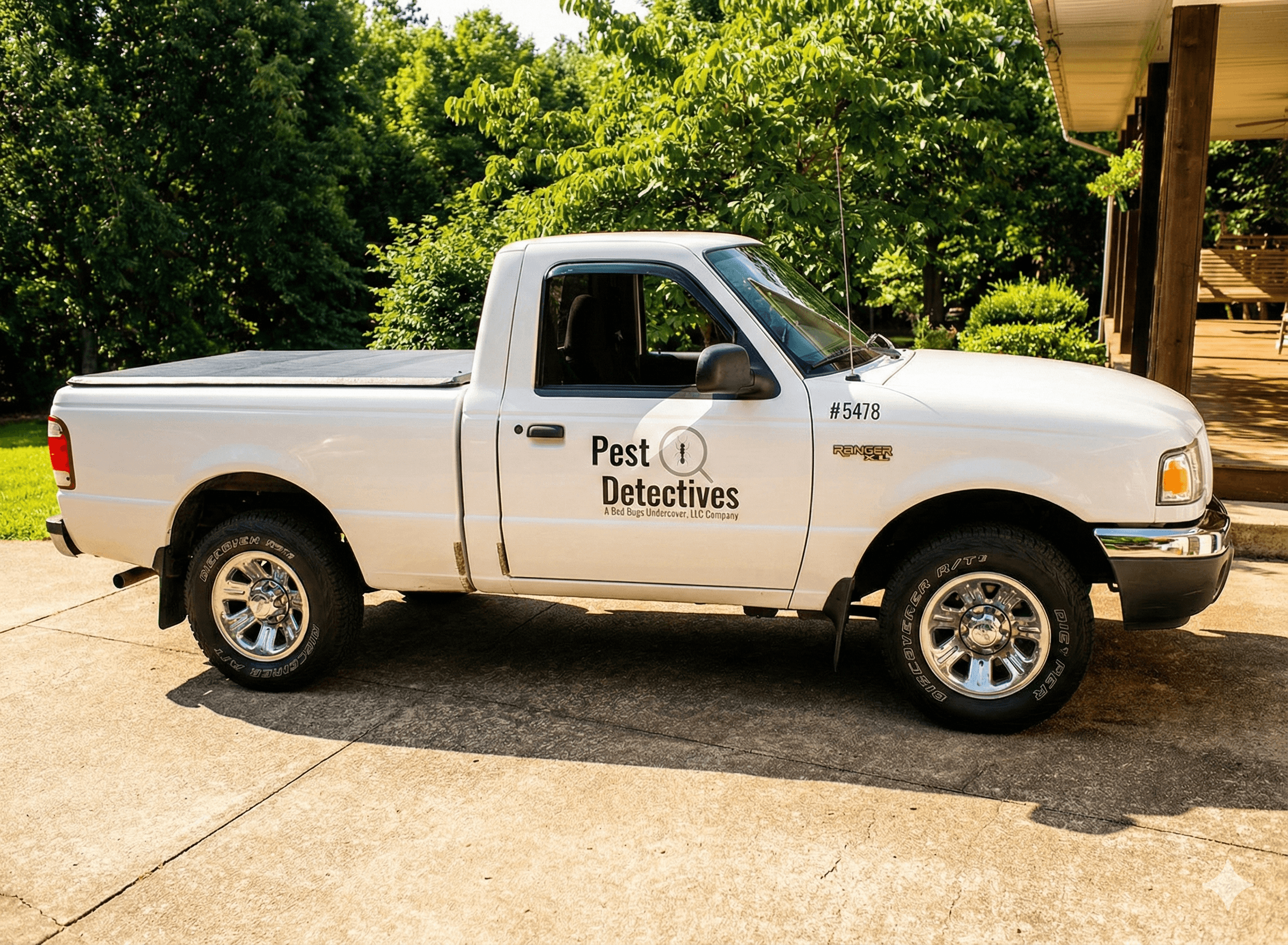

Seeing carpenter ants indoors this winter in Bristol, TN? Learn what repeated sightings, moisture, sawdust, and winged ants can reveal about an indoor nest.

Finding a large ant walking across your bathroom floor in December feels out of place. Maybe you notice several dark ants around the kitchen sink, a few insects near a window frame, or a small pile of sawdust-like material below a piece of trim.
The obvious question is: Why are carpenter ants in my house in winter?
Seeing one carpenter ant indoors during cold weather does not automatically prove that a colony is nesting inside your home. An isolated worker can sometimes be carried indoors with firewood. But repeated carpenter ant activity in winter deserves closer attention, especially when ants keep appearing in the same room or you also notice moisture, coarse wood debris, or winged ants.
University of Minnesota Extension notes that carpenter ants can remain active indoors during winter when a nest receives enough warmth from the structure. It also identifies firewood as an exception because workers can accidentally be carried inside.
For Bristol homeowners dealing with recurring activity, Pest Detectives provides professional ant control focused on identifying the ant species, inspecting likely nesting and travel areas, and treating the source of the activity.
Seeing Carpenter Ants Indoors This Winter? The Quick Answer
Carpenter ants indoors in winter can be a sign of a nest somewhere inside the structure, but one isolated ant is not enough to diagnose an indoor infestation. Context matters.
A carpenter ant that appears shortly after you carried firewood indoors may simply have been transported with the wood. Several workers appearing repeatedly around a bathroom, dishwasher, wall, or window during cold weather create a different pattern.
When evaluating carpenter ants in winter, pay attention to how often you see them, where they appear, whether firewood was recently brought indoors, whether the area has moisture problems, and whether you have found winged ants or sawdust-like debris. If you live locally, you can also review Pest Detectives' information about pest control in Bristol, TN and the pests commonly treated in Bristol homes.
One Carpenter Ant or Repeated Winter Activity? Why the Difference Matters
One of the biggest mistakes homeowners can make is treating every carpenter ant sighting as equal. A single ant cannot tell you where it came from. Repeated activity gives you more information.
What you're seeing | What it may mean |
|---|---|
One worker shortly after bringing firewood inside | Could be an incidental introduction |
One ant with no additional activity | Monitor for other evidence |
Several workers appearing repeatedly | More reason to investigate an indoor source |
Ants repeatedly appearing away from obvious food | Nearby nesting or travel activity may need investigation |
Carpenter ants around a sink or bathroom during winter | Check nearby moisture conditions and structural voids |
Coarse sawdust-like debris with recurring ant activity | Stronger evidence of nearby excavation |
Numerous winged carpenter ants emerging indoors | Strong reason to investigate an indoor nest |
There is no useful universal rule such as "three ants means an infestation" or "five ants means there is a nest in the wall."
Look for a pattern instead. Where are the ants appearing? Are they showing up on several different days? Is the activity concentrated around the same wall or plumbing area? Did it begin immediately after firewood was brought into the house? Has there been a roof, plumbing, window, or moisture problem nearby? Those details tell you much more than the number of ants in one room on one night.
Could the Carpenter Ant Have Come In With Firewood?
Yes. This is one of the most important exceptions when discussing carpenter ants in a house during winter.
Carpenter ants commonly nest outdoors in wood such as logs, stumps, roots, and other wooden materials. When firewood is stored outside and later carried into a warm home, individual workers can come with it. University of Minnesota Extension specifically notes that carpenter-ant workers may be carried inside on firewood and that those transported workers cannot establish a new colony by themselves. So if you find one large ant shortly after carrying firewood inside, do not immediately assume that carpenter ants are living in your walls.
The situation becomes more suspicious when ants continue appearing after the firewood has been removed or when activity occurs repeatedly in parts of the home that have no connection to stored wood. The useful distinction is between an ant accidentally introduced into the house and ant activity originating somewhere within the structure.
Why Winter Carpenter Ant Activity Can Point to an Indoor Nest
Carpenter-ant activity outdoors decreases as temperatures fall. A heated house is different.
Wall voids, plumbing areas, insulation, structural wood, and other protected spaces can remain considerably warmer than outside conditions. If a carpenter-ant nest is positioned in one of those areas and receives enough heat, workers can become active even during winter.
University of Minnesota Extension specifically notes that carpenter ants nesting indoors may become active when a nest receives warmth from indoor heating, sunlight, or mild temperatures. Workers may then move through kitchens, bathrooms, cabinets, sinks, dishwasher areas, and other places while looking for moisture. That is why recurring winter activity matters. The question is not simply why the ant is awake in winter. The more useful question is where the ant is coming from.
Where Carpenter Ants May Nest Inside a Bristol Home
Carpenter ants do not choose nesting locations randomly. Moisture-affected wood, hidden voids, insulation, and protected structural spaces can provide suitable conditions. That does not mean every ant seen near a sink is nesting beneath the sink. Visible workers may travel some distance from the actual nest.
Around Sinks, Showers, and Dishwashers
Kitchens and bathrooms deserve attention because plumbing, condensation, leaks, and repeated water exposure can create damp conditions.
University of Minnesota Extension lists areas around tubs, sinks, showers, dishwashers, bathroom tiles, and other moisture-affected locations among places where carpenter-ant nests may occur.
If carpenter ants are appearing near a sink, consider whether the cabinet, nearby wall, plumbing penetration, or adjacent wood has a history of leaking or moisture.
Around Windows and Door Frames
Window and door areas can develop moisture problems from failed seals, exterior water intrusion, condensation, or aging materials.
Ant activity around one of these areas does not establish the location of a nest, but repeated activity combined with moisture damage deserves investigation.
Inside Wall Voids
A worker emerging from beneath a baseboard or through a small wall opening may be traveling from a concealed void.
This is one reason simply killing the ant you can see does not reveal the extent of the problem.
Around Porch and Exterior Wood Connections
Wooden porch components, framing connections, decks, exterior trim, and other transitions between indoor and outdoor materials can provide travel routes or suitable nesting conditions, especially when moisture is present.
Attics, Roof Areas, and Moisture-Affected Wood
Roof leaks and condensation can affect rafters, beams, sheathing, and other wooden components. Carpenter ants can also occupy wall voids, insulation, hollow spaces, and areas beneath roofing.
An ant found upstairs does not automatically mean there is an attic nest. Other evidence needs to support that conclusion.
What the Location of the Ants Can Tell You
The room where you see carpenter ants is useful evidence, but it should be treated as a starting point rather than the confirmed location of the colony.
Where ants keep appearing | What deserves inspection |
|---|---|
Kitchen sink | Plumbing area, cabinet voids and nearby wall |
Dishwasher | Leak history, connections and adjacent wall void |
Bathroom | Tub, shower, sink, trim and nearby walls |
Window | Frame, surrounding wood and signs of water intrusion |
Exterior door | Frame and surrounding wall |
Porch connection | Columns, framing and moisture conditions |
Upper floor or ceiling | Connected wall or roof areas when other evidence is present |
The place where you see carpenter ants is not always the place where the nest is located.
Workers forage away from their nesting areas, and carpenter ants can also maintain satellite nests separate from a parent colony.
What Are the Strongest Signs of a Carpenter Ant Nest Indoors?
No single clue should be interpreted in isolation. Several pieces of evidence occurring together provide a much stronger reason to investigate.
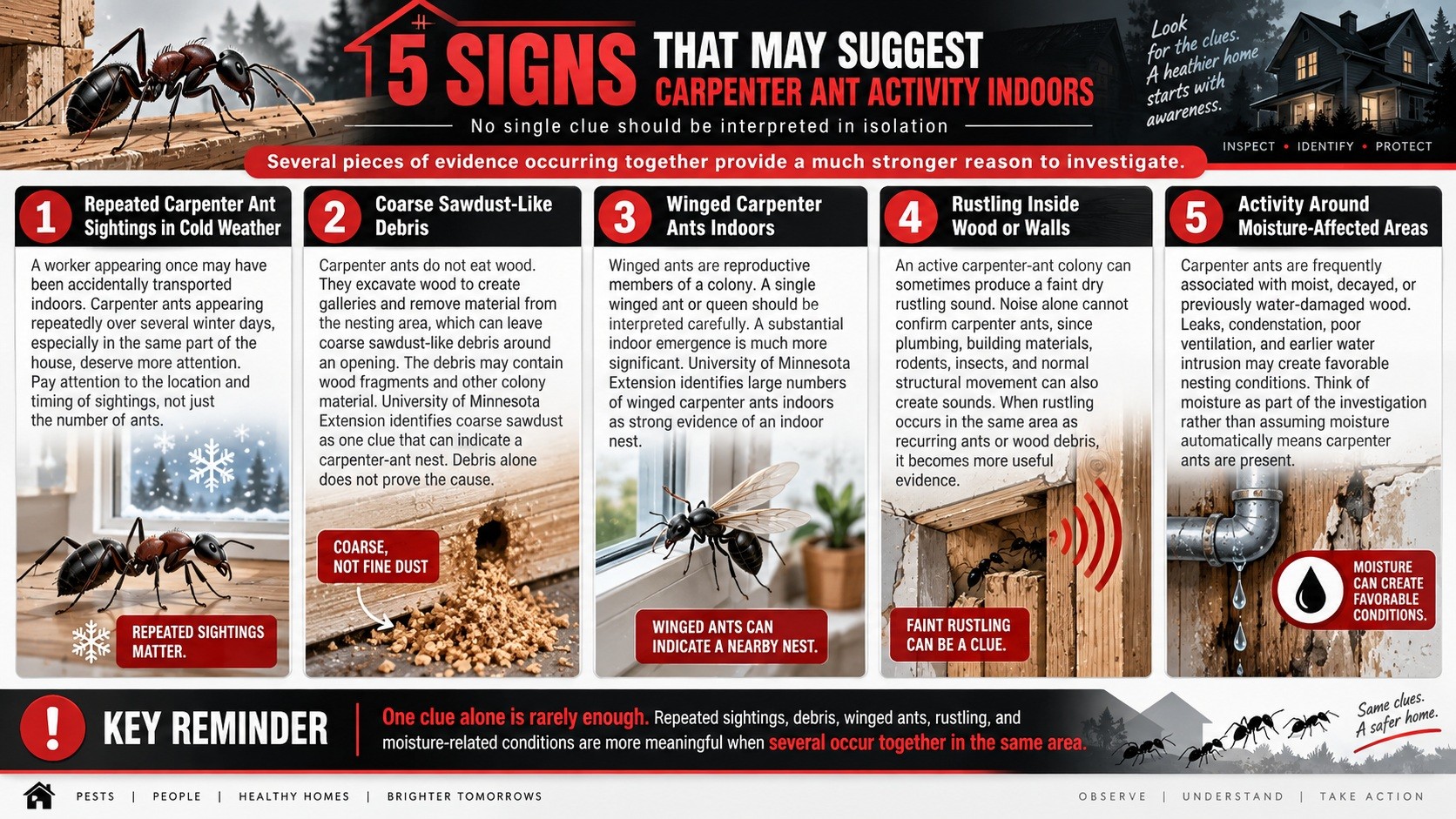
Repeated Carpenter Ant Sightings in Cold Weather
A worker appearing once may have been accidentally transported indoors.
Carpenter ants appearing repeatedly over several winter days, particularly in the same part of the house, deserve more attention.
Pay attention to the location and time of the sightings rather than only counting ants.
Coarse Sawdust-Like Debris
Carpenter ants do not eat wood.
They excavate wood to create galleries and remove material from the nesting area. That activity can produce coarse sawdust-like debris around an opening.
The debris may contain wood fragments along with other material from the colony. University of Minnesota Extension identifies coarse sawdust as one clue that can indicate a carpenter-ant nest.
Finding debris does not prove the cause by itself. The surrounding evidence still matters.
Winged Carpenter Ants Indoors
Winged ants are reproductive members of a colony.
A single winged ant or queen should be interpreted carefully. A substantial indoor emergence is much more significant.
University of Minnesota Extension identifies large numbers of winged carpenter ants indoors as strong evidence of an indoor nest.
Rustling Inside Wood or Walls
An active carpenter-ant colony can sometimes produce a faint dry rustling sound.
Noise alone cannot confirm carpenter ants. Plumbing, building materials, rodents, insects, and normal structural movement can also create sounds.
When rustling occurs in the same area as recurring carpenter ants or wood debris, it becomes more useful evidence.
Activity Around Moisture-Affected Areas
Carpenter ants are frequently associated with moist, decayed, or previously water-damaged wood.
Leaks, condensation, poor ventilation, and previous water intrusion may create favorable nesting conditions.
Think of moisture as part of the investigation rather than assuming moisture automatically means carpenter ants are present.
Do Carpenter Ants Eat the Wood in Your House?
No.
Carpenter ants excavate wood to create galleries. They do not consume wood the way termites consume cellulose.
That distinction matters because carpenter ants and termites require different identification and treatment strategies.
Carpenter-ant galleries tend to be clean and smooth because the ants remove excavated material. Termite damage has different characteristics depending on the termite involved.
If you are uncertain which pest you have, Pest Detectives has a separate guide explaining carpenter ants vs. termites in more detail.
Carpenter Ants or Termites? Don't Guess From Sawdust or Wings Alone
Carpenter ants and termites are both associated with wood, and winged forms of either pest can confuse homeowners.
But they are not the same problem.
Carpenter ants excavate wood to create nesting galleries. Termites feed on cellulose. Their bodies, nesting behavior, damage patterns, and treatment requirements differ.
Trying to identify them based only on the word "sawdust," the color of the insect, or the presence of wings can lead to the wrong conclusion.
For a closer look at identification, body differences, galleries, swarmers, and damage patterns, read the Pest Detectives guide on how to tell carpenter ants from termites.
What If the Ants Are Small Instead of Large?
Not every ant appearing indoors during winter is a carpenter ant.
Pest Detectives' Ant Control page lists several ants encountered across the Tri-Cities, including carpenter ants, odorous house ants, pavement ants, and fire ants.
Color alone is also a poor identification method.
A dark or black ant is not automatically a carpenter ant. Body size, body structure, behavior, location, nesting evidence, and other characteristics are more useful.
Correct identification matters because different ant species can have very different nesting habits. Treating every indoor ant as though it were a carpenter ant can mean focusing on the wrong source.
Why Are Carpenter Ants Showing Up Around the Sink or Bathroom?
Water is often the reason bathrooms and kitchens become useful places to investigate.
Workers may visit a sink simply because they are searching for moisture. The nest could be nearby, somewhere else inside the building, or in some cases outside.
Look at the broader area.
A dishwasher may have a slow connection leak. A bathroom wall may have previous plumbing damage. A shower enclosure may allow water into nearby materials. A window beside the sink may have moisture intrusion around the frame.
Carpenter ants are associated with areas around tubs, sinks, showers, dishwashers, plumbing, moisture-damaged wood, wall voids, roofing, and attic components.
That is why finding ants around a sink should lead to investigation rather than the assumption that the colony is directly under the faucet.
Where you see the ants is not necessarily where the colony is located.
Why Killing the Ants You See May Not Solve the Nest
The carpenter ants walking across a counter or bathroom floor are workers.
Removing those workers may reduce what you see temporarily, but it does not tell you where the nest is or whether additional nesting sites exist.
University of Minnesota Extension notes that spraying foraging workers does not eliminate a hidden carpenter-ant nest because only part of the colony is out foraging and the nest itself may remain protected inside a wall void, ceiling, floor, attic, hollow door, or another concealed area.
That is also why Pest Detectives' Ant Control service begins with identification and inspection. Its published process includes identifying the ant species, tracking activity, locating nesting or entry areas, creating a treatment plan, and addressing conditions that may contribute to recurrence.
The objective is not simply to kill the workers currently visible on the floor.
It is to understand where the activity is coming from.
What Should You Do If You Find Carpenter Ants Indoors This Winter?
Note exactly where and when you see the ants. Photograph one if possible so the identification does not depend on memory. Check whether firewood was recently carried indoors, and remove stored firewood from living areas. Watch for repeated activity over the following days rather than relying on one sighting. Inspect accessible areas for obvious plumbing leaks, condensation, past water damage, coarse sawdust-like debris, or winged ants. Avoid tearing apart walls, trim, or other structural materials trying to locate a nest. If activity continues, have the area inspected so the ant species and likely source can be identified.
Recurring pest activity, unexplained wood debris, moisture problems, wings, structural damage, and repeated DIY failures can all justify a closer inspection. Pest Detectives covers these warning signs in its guide to signs you may need a professional pest inspection.
When to Schedule Carpenter Ant Control in Bristol, TN
Consider arranging an inspection when carpenter ants continue appearing during winter rather than disappearing after one isolated sighting.
Other reasons to investigate include ants repeatedly emerging from the same wall or structural gap, recurring activity around moisture-damaged areas, coarse wood debris appearing below trim or wood, numerous winged carpenter ants indoors, continued activity after firewood has been removed, or uncertainty about whether the insect is actually a carpenter ant.
Temporary relief from killing visible workers is another reason to look for the source.
Pest Detectives provides ant control in Bristol, TN as part of its Tri-Cities service coverage. Its Bristol service-area page also lists ant treatment among the pest-control services available to local homes and businesses.
How Pest Detectives Team Investigate Carpenter Ant Activity in Bristol Homes
Carpenter-ant control starts with identification. Pest Detectives' published Ant Control process says technicians inspect for the species involved, ant trails, nesting areas, entry points, and conditions supporting the activity. The inspection can then concentrate on the parts of the property that match the evidence: kitchens, bathrooms, structural wood, wall transitions, plumbing areas, moisture zones, and exterior access points.
The next step is tracing activity toward possible nesting or entry areas. That distinction matters because the carpenter ants walking through the kitchen may only be workers traveling from another location.
Treatment can then be based on the ant species, activity location, accessible nesting areas, and conditions found during the inspection rather than applying the same approach to every ant problem. Where appropriate, recommendations may also involve correcting moisture problems or reducing access points that allow ants to continue entering the structure.
Frequently Asked Questions About Carpenter Ants in Winter
Q.1 Why am I seeing carpenter ants in my Bristol home during winter?
Recurring winter carpenter-ant activity can occur when a nest is located in a part of the structure that receives enough heat for workers to become active. An isolated worker can also be carried indoors with firewood, so the number, location, and pattern of sightings matter.
Q.2 Does one carpenter ant mean there's a nest inside?
Not necessarily. One worker can enter accidentally or arrive with firewood. Repeated cold-weather activity, winged ants, coarse debris, or recurring ants around the same structural area provide more reason to investigate.
Q.3 Can carpenter ants come inside with firewood?
Yes. Workers can be transported indoors in firewood. Those workers alone cannot establish a new colony. Continuing activity after the firewood has been removed deserves closer attention.
Q.4 Why are carpenter ants around my bathroom or kitchen sink?
Workers may be searching for moisture, and carpenter ants can also nest in moisture-affected areas around plumbing, sinks, showers, dishwashers, walls, or nearby wood. The actual nest may not be directly beneath the place where you see the ants.
Q.5 What does carpenter ant sawdust look like?
Carpenter ants can push coarse sawdust-like wood debris from areas they excavate. Finding the material with recurring carpenter-ant activity makes it more useful as a nesting clue, but debris alone should not be treated as a confirmed diagnosis.
Q.6 Do carpenter ants eat wood?
No. Carpenter ants remove wood while excavating galleries for nesting. They do not consume the wood like termites.
Q.7 Who provides carpenter ant control in Bristol, TN?
Pest Detectives provides ant control services in Bristol and throughout the Tri-Cities. Its service process includes ant identification, inspection of activity and nesting areas, targeted treatment, and recommendations for conditions that may contribute to recurring activity.
Seeing Carpenter Ants Indoors This Winter in Bristol?
One carpenter ant does not automatically mean a colony is living inside your home, especially if firewood was recently carried indoors. Repeated winter sightings are different. If carpenter ants continue appearing, you notice winged ants, find coarse sawdust-like debris, or see activity around moisture-affected structural areas, the source deserves investigation.
Pest Detectives can identify the ant, inspect likely nesting and travel areas, and determine an appropriate control plan for your Bristol property. Contact Pest Detectives to request service or discuss the carpenter-ant activity you are seeing.