

Keep catching mice in your Johnson City home? Learn why mice return after trapping, where they may be getting in, and what can stop the cycle.

Why mice keep coming back after you set traps in your Johnson City home
You caught a mouse, reset the trap, and thought the problem was handled. Then another mouse showed up. Maybe you found fresh droppings under the kitchen sink a few days later, heard scratching behind a wall at night, or caught another mouse in exactly the same part of the house. After several catches, it starts to feel as though the mice simply keep replacing one another.
The traps may actually be working. Catching a mouse tells you that the trap removed that particular animal. It does not tell you whether another mouse was already inside, whether mice are moving through a part of the house your traps do not cover, or whether an opening somewhere around the building is allowing new mice to enter.
That difference matters. If several mice were already inside, the immediate job is finding and removing the remaining activity. If new mice are entering after previous mice have been caught, continuing to add traps without finding the entry route can turn into the same cycle over and over again.
Pest Detectives' professional mice control services are built around this wider problem. The service includes inspecting areas such as attics, crawl spaces, garages, kitchens, and utility lines, looking for evidence of mouse activity and possible access points instead of treating the trap itself as the whole solution.
Caught a mouse but still seeing signs? Pay attention to what happens next
What happens after a mouse is caught can give you useful information about what is happening elsewhere in the house.
If you catch a mouse on Monday and hear scratching again that night, another mouse may already be inside. If fresh droppings continue appearing in the same cabinet after the old droppings have been safely cleaned, the activity has probably not stopped. If the house becomes quiet for several weeks and then signs suddenly return, continued entry from outside becomes a more reasonable possibility.
The pattern can also tell you whether your traps are intersecting the active route. You might have a trap in the kitchen because that is where you saw the first mouse, but new droppings begin appearing in the laundry room while the kitchen trap remains untouched. In that case, the activity may have shifted, or the kitchen may never have been the main travel route in the first place.
What happens after the catch | What it may suggest |
|---|---|
New signs continue immediately | Other mice may still be inside |
Fresh signs appear but traps are untouched | The traps may not be along the active travel route |
Activity stops and returns weeks later | New mice may still have a way into the structure |
Mice repeatedly appear in one room | A nearby travel route, feeding area, or opening may be involved |
Activity appears in several areas | Mice may be moving through connected wall, attic, crawl-space, or utility routes |
These are clues rather than proof. One mouse does not automatically mean a large infestation, and a week without a catch does not automatically mean every mouse is gone. The useful question is whether new evidence continues appearing after each catch.
Are these mice that were already inside, or new mice getting in?
These situations can look almost identical when all you see is another mouse in the trap.
Suppose you catch one mouse in the kitchen and then find fresh droppings behind the refrigerator the following morning. It would make sense to investigate whether more activity was already present in that part of the structure. Mice can move through wall voids, cabinets, stored materials, insulation, attics, crawl spaces, and other sheltered areas without spending much time in the open.
Now consider a different pattern. You catch two mice, clean the affected areas, and then see no obvious evidence for several weeks. Later, you start finding new droppings near the garage or hearing movement inside a wall again. That gap between periods of activity makes continued access from outside worth investigating.

The distinction is especially useful when the same problem happens repeatedly during the year. A homeowner might catch mice every fall, see no activity for months, and then repeat the exact process when colder weather returns. Those are not necessarily the same mice returning. A structural opening that remains available can allow different mice to use the same route at different times.
Where the mouse appears does not always tell you where it entered either. A mouse may enter through a garage, crawl space, utility opening, or exterior gap and then travel through protected parts of the structure before appearing in a kitchen or pantry. The timing of the activity after trapping can therefore be as useful as the catch itself.
Why traps can work without solving the mouse problem
When someone says their mouse traps are not working, there are actually two different situations they might be describing.
Sometimes the trap is not catching anything. Placement can be part of the reason. A trap sitting in the middle of an open room may never cross the route mice regularly use behind appliances, along walls, or between a hiding area and a food source. Activity can also change location as food, shelter, or access changes.
The second situation is different: the traps are catching mice, but the catches do not stop.
If you have already caught several mice, the trap has clearly done its job on several individual animals. Continued catches can mean other mice were present, another area of the house remains active, or new mice are continuing to enter through an opening that has not been found.
A trap cannot close a gap around a utility line. It cannot replace a damaged garage-door sweep or correct an opening around a crawl-space access door. It also cannot tell you whether a hole behind a kitchen cabinet leads only into a wall void or eventually connects to an opening on the outside of the house.
This is why Pest Detectives includes mice and other rodents within its wider pest control services rather than treating trapping as an isolated task. Finding the active pest and understanding how it is using the property determine what needs to happen next.
How do you know if mice are still active?
Look for evidence that is new or changing.
Droppings are one of the clearest examples. Finding droppings behind a stove tells you that a mouse used that area at some point, but it does not tell you exactly when. If the area is properly cleaned and new droppings start appearing afterward, that gives you much stronger evidence that mice are still using the space.
The same reasoning applies to food packaging. An old chew mark on a cardboard box could have been made before the last mouse was caught. A cereal packet that was intact yesterday and damaged this morning points to current activity. Fresh gnawing, newly disturbed insulation, additional nesting material, and repeated sightings can all help build a clearer picture.
Noises should be considered alongside the other evidence. Houses can produce plenty of unexplained sounds, so one noise inside a wall does not identify an animal. Repeated scratching or scurrying in the same area, particularly when you are also finding droppings or gnawing nearby, deserves closer attention.
Trap activity is useful as well. Continued catches show that mice remain active somewhere within reach of those traps. On the other hand, an untouched trap does not prove that the house is clear. The mouse may be using another route or another part of the structure.
There is no universal number of mouse-free days that proves an infestation is over. It is more useful to look for several changes together: no new catches, no new droppings, no fresh damage, and no continued activity around the areas that were previously affected.
Why do I keep catching mice in the same room?
A room where mice are repeatedly caught may be a feeding area, a travel route, an access point, or simply the first exposed part of a much larger hidden pathway.
Kitchens are a common example. Food makes the room useful to mice, but kitchens also contain plumbing lines, cabinets, appliance voids, gaps around pipes, and openings where electrical or other services pass through walls and floors. A mouse can spend most of its time elsewhere and repeatedly visit the kitchen to forage.
Garages present a different set of conditions. A worn bottom seal can leave gaps along the garage door. Utilities can pass through exterior walls, and the wall connecting the garage with the house may contain its own penetrations. Storage boxes and other undisturbed materials can also give mice protected places to move or hide.
If you keep catching mice in an attic, the relevant route may involve vents, soffits, roofline transitions, or openings around utilities. In a crawl space, attention may shift toward the access door, vents, foundation openings, plumbing lines, and the places where the crawl space connects to the rest of the house.
Where the mouse is caught is useful evidence, but it should be treated as the beginning of the inspection rather than proof of where the mouse originally entered.
Where mice may be getting into a Johnson City home
A recurring mouse problem often requires you to stop looking only at the room containing the trap and start looking at the house as one connected structure.
Homes contain dozens of places where different materials meet: siding and foundation, pipes and walls, doors and thresholds, rooflines and soffits, vents and framing, HVAC lines and exterior walls. Age, repairs, renovations, weather exposure, and normal wear can leave gaps around some of these transitions.
For homeowners dealing with rodents locally, Pest Detectives' page for pest control in Johnson City, TN provides information about the company's Johnson City service coverage and pest-control options in the area.
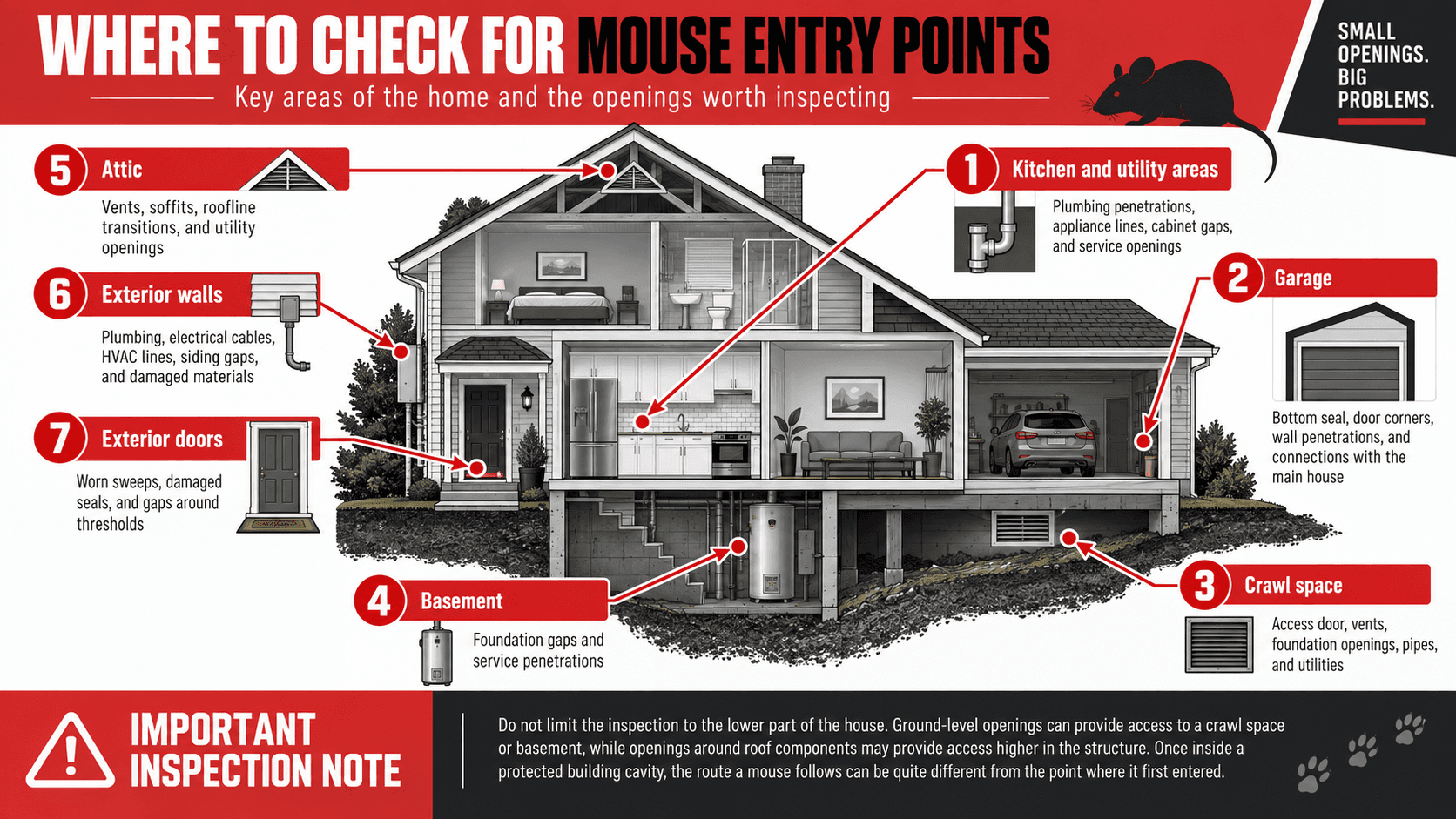
When the specific problem is mice, these are some of the areas worth checking:
Area of the home | Openings worth inspecting |
|---|---|
Kitchen and utility areas | Plumbing penetrations, appliance lines, cabinet gaps, and service openings |
Garage | Bottom seal, door corners, wall penetrations, and connections with the main house |
Crawl space | Access door, vents, foundation openings, pipes, and utilities |
Basement | Foundation gaps and service penetrations |
Attic | Vents, soffits, roofline transitions, and utility openings |
Exterior walls | Plumbing, electrical cables, HVAC lines, siding gaps, and damaged materials |
Exterior doors | Worn sweeps, damaged seals, and gaps around thresholds |
Do not limit the inspection to the lower part of the house. Ground-level openings can provide access to a crawl space or basement, while openings around roof components may provide access higher in the structure. Once inside a protected building cavity, the route a mouse follows can be quite different from the point where it first entered.
This is one reason homeowners sometimes seal a visible gap in the room where they caught the mouse and still see activity later.
You sealed one hole. Why are mice still appearing?
Finding a hole and sealing it feels like a clear solution. Sometimes it is. But if mice continue appearing afterward, the opening may have been only one part of the route.
A gap behind a kitchen cabinet, for example, may connect the kitchen to a wall cavity without being the place where the mouse entered the building. Closing that interior gap can change where the mouse appears while leaving the exterior entry route untouched.
There may also be multiple exterior openings. Plumbing, vents, cables, doors, crawl spaces, siding transitions, roof components, and other building features create more than one place that may need to be inspected. Finding one obvious defect does not confirm that it is the only one.
Another possibility is that the exclusion work succeeded but one or more mice were already inside before the opening was repaired. Those mice still have to be removed. In that situation, seeing another mouse after a hole has been closed does not automatically mean the repair failed.
The repair material also matters. Exposed expanding foam by itself should not be treated as a permanent mouse-proof barrier where rodents can reach and damage it. The correct repair depends on the location and construction of the opening.
Mouse exclusion is therefore a building-wide inspection problem, not simply a search for one visible hole.
Why a clean Johnson City home can still have mice
Finding mice in a clean house can be confusing because rodent problems are often associated with garbage, crumbs, clutter, or poor housekeeping.
Those conditions can certainly make a home more useful to mice. Accessible food gives them something to eat, clutter can provide protected nesting areas, and improperly stored pet food or pantry goods can support continued activity.
But cleanliness does not close an opening in a building.
A spotless kitchen can still have a gap around a pipe beneath the sink. An organized garage can still have a damaged door seal. A recently renovated home can still have an opening where a utility passes through an exterior wall. Crawl-space, foundation, attic, and roofline openings are also largely separate from how clean the living areas are.
Sanitation should therefore be treated as one part of mouse prevention. Store food securely, clean spills and crumbs, manage trash, and reduce unnecessary clutter, but do not assume that housekeeping alone will stop a problem caused by continued structural access.
Why mice may become more noticeable in fall and winter
Rodents can be a year-round problem, but colder weather changes the shelter and food options available outdoors. Protected indoor spaces become attractive when exterior conditions become less favorable.
Pest Detectives' guide to the most common household pests in Johnson City specifically identifies rodents among the pests local homeowners encounter and notes increased concern around colder periods of the year. The guide also covers common rodent signs such as scratching, droppings, gnawing, and nesting material.
The useful part for a homeowner dealing with repeated mouse problems is the history of the house. If mice showed up last winter and return again this winter, the individual animals do not have to be the same. An opening that was never found or repaired may still be providing a usable route into the structure.
The location of recurring activity matters too. If the garage produces catches every fall, that area deserves closer inspection. If sounds repeatedly begin in the attic when temperatures fall, roofline and attic-access routes deserve attention. Seasonal repetition can give the technician another clue about where to investigate.
What actually breaks the trap-and-return cycle?
Recurring mouse control usually begins with finding where the current activity is concentrated. Fresh droppings, repeated catches, gnaw marks, nesting material, food damage, or consistent nighttime noises can help identify which areas deserve attention.
Mice already inside then need to be addressed. Trapping can be part of that process, but placement should follow the activity instead of spreading traps randomly throughout the house.
The structural inspection answers a different question: how are mice reaching the inside of the building? Depending on the property, that may involve checking the garage, crawl space, attic, exterior doors, foundations, vents, utility penetrations, roof transitions, or other accessible parts of the structure.
Once likely access points are identified, appropriate exclusion work can reduce the chance of additional mice following the same route. Food storage, sanitation, moisture issues, and clutter should also be addressed where they are supporting activity.
Then the property needs to be monitored. Another catch, a fresh dropping, or new activity in a previously quiet area provides information about whether the problem is continuing and where the next inspection should focus.
Removal, exclusion, sanitation, and monitoring do different jobs. Trapping mice without investigating continued access is one reason the catch-reset-catch cycle can keep repeating.
When repeated trapping means it is time for a professional mouse inspection
Catching one mouse does not automatically mean you need professional pest control. Repeated activity changes the situation.
If you have caught several mice and continue finding fresh evidence, hear persistent movement in walls or ceilings, notice activity shifting between rooms, or cannot locate where the mice are entering, an inspection can provide information that another trap cannot.
Pest Detectives has a separate guide covering signs your home may need a professional pest inspection. Recurring activity after DIY efforts is one of the situations where inspecting the structure, identifying the pest correctly, and deciding whether trapping, exclusion, repair, monitoring, or another response is appropriate becomes useful.
Recurring seasonal problems deserve the same attention. If the same area produces mice every winter, catching the current animals may quiet the problem again, but it still leaves the question of why that part of the house remains accessible.
Professional mice control in Johnson City and the Tri-Cities can combine inspection, targeted trapping, sanitation recommendations, exclusion options, and follow-up instead of treating every new catch as a separate incident.
How Pest Detectives handles recurring mouse problems
Pest Detectives begins by looking for evidence of where mice are active. The company's mice-control process includes inspecting areas such as attics, crawl spaces, garages, kitchens, and utility lines for droppings, rub marks, gnawing, nesting areas, and possible entry points.
That inspection helps determine where trapping or removal should be concentrated. A mouse seen in the kitchen does not automatically mean the kitchen is the only active area, so the visible sighting needs to be considered alongside the rest of the evidence in the structure.
Potential access points are then part of the same investigation. Pest Detectives says its mice service includes identifying where mice are getting in and recommending exclusion measures such as sealing gaps, screening vents, or reinforcing weak points where appropriate.
Sanitation recommendations can address conditions such as accessible food, clutter, or moisture that support mouse activity once the mice are inside. Follow-up then provides another opportunity to check whether signs continue and whether trapping locations or the control approach need to change.
That combination makes sense for recurring activity because the question is no longer simply how to catch the next mouse. The goal is to understand why another mouse keeps appearing.
Frequently asked questions about mice coming back after traps
Q.1 Why do mice keep coming back after I trap them?
Some of the mice you catch may already have been inside when you caught the first one. New mice may also be entering through an exterior opening that remains accessible. Trapping removes individual animals but does not automatically close the route that allowed them inside.
Q.2 If I caught one mouse, are there probably more?
One mouse does not prove that several more are present. Continued evidence is more useful. Additional catches, fresh droppings, new gnaw marks, repeated scratching, nesting material, or sightings can indicate that activity is continuing.
Q.3 Why do I keep catching mice in the same spot?
The trap may be sitting along an established travel route between a hiding area and food. The location may also be close to a structural opening or connected wall void. Look beyond the exact spot where the trap sits and consider what is behind nearby appliances, cabinets, walls, pipes, doors, or other building features.
Q.4 How do I know if mice are still active?
Look for new evidence rather than relying on old signs. Fresh droppings after cleaning, new damage to food packaging, additional gnawing, recent nesting material, repeated sounds, sightings, and continued trap catches can all indicate ongoing activity.
Q.5 Why did the mice disappear and then come back weeks later?
The first trapping effort may have removed the mice that were inside at the time while leaving an entry route available. Another mouse could later use the same route. The timing and location of the returning activity can help determine whether continued entry should be investigated.
Q.6 Can mice enter through a garage or crawl space?
Yes. Garage-door gaps, crawl-space access doors, vents, foundation openings, utility penetrations, and connections between these spaces and the main house can all deserve inspection when mouse activity is present.
Q.7 Is sealing one mouse hole enough?
Sometimes. If it is the only relevant entry point and any mice already inside are addressed, closing it may solve the access problem. When activity continues, however, another opening or another active area of the structure may still exist.
Still catching mice in your Johnson City home?
If you have already caught several mice and fresh signs continue appearing, another trap may tell you that another mouse is present. It will not tell you how that mouse got there.
Pest Detectives can inspect the active areas of the property, look for likely entry routes, address mice that are already inside, and recommend exclusion measures where structural openings are contributing to the problem.
You can contact Pest Detectives to schedule service for a Johnson City home or another property in the Tri-Cities service area.


