

Finding fleas in your Bristol, TN home without pets? Learn how previous pets, rodents, wildlife, and dormant flea stages can cause an infestation.

Finding fleas in your home is frustrating enough when you have a dog or cat. Finding them when no pets live in the house can be even more confusing. You may notice a tiny insect jumping across the carpet, feel something around your ankles while walking through a room, or discover flea activity shortly after moving into a property that seemed completely clean.
A pet-free home can still have a flea problem because the animal currently living with you is only one possible part of the flea life cycle. Previous pets, rodents, wildlife, visiting animals, infested belongings, or flea stages left behind inside the property may all contribute to activity. In some homes, the original animal host may have disappeared weeks or months before the homeowner notices the first adult flea.
For Bristol, TN homeowners, identifying the source is often more useful than immediately reaching for another spray. Treating the fleas you can see may reduce adult activity, but recurring problems are harder to resolve when the underlying source remains unidentified. A useful investigation considers the history of the property, when the fleas first appeared, where activity is strongest, and whether another animal may be using hidden areas of the home.
Homeowners dealing with ongoing activity can also learn more about professional flea and mite control services from Pest Detectives.
Can You Really Have Fleas in a House With No Pets?
Yes, fleas can occur in a house without dogs or cats. A previous pet may have introduced fleas before you moved in, immature stages may still be developing in carpeting or protected floor areas, or another animal may be supporting the flea population somewhere around the structure.
The presence of fleas does not necessarily mean an animal is currently walking through your living room. Rodents can remain inside wall voids, crawl spaces, garages, attics, and utility areas without being seen regularly. Wildlife and stray animals can also spend time beneath porches, under decks, near crawl-space openings, or around other sheltered parts of a property.
Property history becomes especially important when a flea problem appears in a pet-free home. Instead of asking only, “How can there be fleas if I do not own a pet?” a more useful question is, “What animal was supporting the fleas before, or what animal could still be supporting them now?”
Answering that question usually starts with the timeline.
Start With the Timeline: When Did the Fleas First Appear?
The moment when flea activity first became noticeable can reveal more than homeowners might expect. A flea problem that begins immediately after moving into a previously occupied home suggests a different source from one that begins after weeks of scratching noises in an attic.
Think about what changed shortly before you noticed the first flea. Recent occupancy, a period of vacancy, rodent activity, wildlife around the structure, visiting pets, used furniture, rugs, or stored belongings can all provide useful clues.
Fleas Appeared Soon After You Moved In
Previous occupants may have owned dogs or cats even when there were no obvious signs of pets during the property viewing. Flea eggs and other immature stages can be distributed through areas where animals rested, slept, or spent significant time.
Carpets, rugs, floor gaps, upholstered furniture, baseboard edges, and former resting areas are all worth considering. Removing the pet from the property does not automatically remove every flea stage that has already entered the environment.
A flea problem discovered shortly after move-in may therefore have started before the current homeowner or tenant arrived.
Fleas Appeared After the House Had Been Empty
Vacant homes can produce one of the most confusing flea situations. The property may appear completely quiet during the vacancy, only for adult fleas to become noticeable once people begin moving through the rooms again.
The flea life cycle includes four stages: egg, larva, pupa, and adult. The pupal stage develops inside a protective cocoon, allowing the flea to remain less noticeable while waiting for conditions associated with a potential host.
Normal household activity can change those conditions. Walking across floors, vacuuming, moving furniture, body heat, and carbon dioxide produced by occupants may contribute to adult emergence.
The apparent infestation may therefore feel sudden even though the flea population was already present.
In practical terms, the fleas may be new to you without being new to the house.
Fleas Appeared Around the Same Time as Rodent Activity
Scratching inside walls, droppings in a garage, gnaw marks, nesting material, or noises in an attic deserve attention when fleas are also present.
Mice and rats can carry fleas, which means a pet-free home may still contain a hidden animal host. The rodent may rarely enter occupied rooms while remaining active in a crawl space, attic, garage, wall void, or utility area.
Homeowners who suspect rodents should investigate both problems together rather than automatically treating them as unrelated infestations. Pest Detectives provides dedicated mice control services and rat control services when evidence points toward an active rodent problem.
Fleas Appeared After Wildlife Began Using the Property
Animal activity outside the main living space can also matter. A raccoon, squirrel, opossum, stray cat, or another animal resting around a porch, crawl space, attic, deck, garage, or sheltered exterior area may bring fleas close to the structure.
Finding evidence of wildlife does not automatically mean it caused the flea problem. Repeated animal activity near the same area where flea activity is strongest does, however, make that location worth investigating more carefully.
The relationship between the animal and the property matters more than simply spotting wildlife somewhere in the yard.
Fleas Appeared After Furniture, Rugs, or Visiting Animals Arrived
Recently introduced belongings provide another clue. Used couches, upholstered chairs, rugs, pet bedding, or items moved from another property can occasionally transport fleas or developing flea stages.
Visiting dogs and cats may also introduce fleas, particularly when an animal spends time on carpets, furniture, or other indoor resting areas.
Timing is important here as well. A secondhand couch brought home several days before flea activity began deserves more attention than furniture that has been sitting in the same room for years without a previous problem.
5 Common Sources of Fleas in a Pet-Free Bristol Home
Several explanations are possible when fleas appear in a house without pets. None should be assumed without evidence, but some sources are considerably more common and practical to investigate.
1. Previous Pets Lived in the Home
A previous owner or tenant who kept pets may have unintentionally left part of the flea population behind. Adult fleas spend much of their time associated with an animal host, while eggs can fall into the surrounding environment.
Areas where a pet regularly slept or rested may contain flea stages long after the animal has left. Carpeted rooms, rugs, upholstered furniture, cracks between flooring, and edges around baseboards can all become relevant.
The problem may remain unnoticed during a vacancy or during a brief property inspection. Once the house is occupied again, adult flea activity can become much easier to detect.
2. Flea Pupae Remained During a Vacancy
The pupal stage deserves particular attention because it can make flea activity appear delayed. Flea larvae eventually form cocoons where development continues before the adult emerges.
A home without people or pets may provide relatively few cues associated with a nearby host. Reoccupation changes the environment almost immediately as people walk through rooms, create vibration, warm the space, and produce carbon dioxide.
This delayed emergence explains why some people discover fleas only after moving into a property. The house did not necessarily become infested on moving day. Existing flea stages may simply have become active enough to notice.
3. Mice or Rats Are Acting as Hidden Hosts
Rodent activity changes the source investigation considerably because mice and rats can remain concealed for long periods.
Possible hiding areas include crawl spaces, attics, wall voids, garages, utility rooms, storage areas, and spaces around plumbing or electrical routes. Fleas associated with those animals can eventually become noticeable elsewhere in the home.
Look for supporting evidence rather than assuming rodents are responsible simply because no pets are present. Droppings, gnaw marks, scratching sounds, nesting materials, disturbed insulation, or recurring activity around structural openings provide a stronger reason to investigate further.
Pest Detectives also has information on how to tell whether activity is coming from rats or mice in a Bristol home, which can help when the underlying animal source is unclear.
4. Wildlife or Stray Animals Are Using Sheltered Areas
Wildlife and stray animals do not need to live inside the occupied part of the house to become relevant.
A sheltered location beneath a deck, around a porch, inside an attic, near a crawl space, or along the edge of a garage may provide an animal with a resting or nesting area. Fleas associated with the animal can then occur close enough to the structure to become part of an indoor problem.
Investigating animal activity should remain evidence-based. Tracks, droppings, nesting materials, noises, damaged vents, repeated sightings, or clear access points are more useful than assuming wildlife must be responsible because the house has no pets.
5. Fleas Were Introduced With Belongings or Visitors
Used furniture and rugs are possible introduction routes, particularly when upholstered items previously came from a home with animals.
Visiting pets can create a similar situation. A dog may spend only a few hours in the house, yet fleas or flea eggs associated with the animal can still enter the environment.
People can occasionally transport fleas temporarily on clothing or belongings, although humans should not be treated as the normal long-term host supporting a household flea population. The wider context remains important when determining which introduction route is plausible.
Previous Pet Problem or Current Hidden Animal Source? How to Tell
Distinguishing an older flea problem from a continuing animal source can help determine where to investigate next. No individual clue provides absolute proof, so the strongest conclusions usually come from several pieces of evidence pointing in the same direction.
Clue | More Consistent With Older Flea Activity | More Consistent With a Current Hidden Host |
|---|---|---|
Fleas appeared shortly after moving in | Strong clue | Possible |
Property was vacant before occupancy | Strong clue | Possible |
Previous occupants owned pets | Strong clue | Not required |
Scratching is heard in walls or attic | Less likely | Stronger clue |
Rodent droppings or gnaw marks are present | Unlikely | Strong clue |
Wildlife repeatedly uses part of the structure | Unlikely | Strong clue |
Fleas are strongest near crawl-space access | Possible | Stronger clue |
Activity continues despite repeated indoor cleaning | Possible | Continuing source should be investigated |
Words such as “suggests,” “may indicate,” and “is more consistent with” are useful here because pest activity rarely provides a perfect single-clue diagnosis.
A home can also contain evidence from both categories. Rodents or pets may have created the original infestation and later disappeared while environmental flea stages remained. Successful source identification therefore requires looking at the full history rather than choosing one explanation too early.
What the Room Where You Find Fleas Can Tell You
Location is another useful diagnostic clue. Fleas appearing in a carpeted living room immediately after move-in create a different pattern from activity concentrated around a crawl-space entrance.
Where Fleas Are Most Noticeable | What May Be Worth Investigating |
|---|---|
Carpeted living room after move-in | Previous pet activity or remaining flea stages |
Bedroom with older carpeting | Former animal resting area |
Near crawl-space access | Rodent or wildlife activity |
Basement | Rodents or historic animal activity |
Area beside or below an attic | Rodent or wildlife source |
Garage | Rodents, visiting animals, or stray animals |
Door leading toward a porch or deck | Animal activity close to the structure |
Recently purchased couch or rug | Introduced item |
Several rooms throughout the house | More established environmental activity |
Location should guide the investigation rather than serve as proof. Fleas near a crawl-space opening do not automatically confirm an animal beneath the house, just as fleas in carpet do not prove a previous tenant owned pets.
Patterns become more meaningful when the location matches the timeline and other physical evidence.
Why Fleas Can Suddenly Appear After Moving Into a Vacant Bristol Home
A vacant property may appear completely flea-free before occupancy. No one is walking across carpets, furniture remains undisturbed, and there may be little activity inside the rooms.
Flea pupae can complicate the picture because the developing flea remains protected inside a cocoon. Once people begin occupying the house, environmental conditions change quickly.
Foot traffic creates pressure and vibration. Vacuuming disturbs carpets and flooring. Human presence introduces warmth and carbon dioxide. These conditions can contribute to adult fleas emerging from their cocoons.
Several fleas appearing during the first few days of occupancy can therefore look like a brand-new infestation even when the original flea activity occurred much earlier.
Property history becomes especially valuable in this situation. A home that previously contained pets and then remained vacant presents a very different diagnostic picture from a home that has been continuously occupied without animals.
Can Mice and Rats Bring Fleas Into a Bristol Home?
Mice and rats can carry fleas, making rodents an important possibility when fleas appear in a house without dogs or cats.
Rodents often occupy places homeowners do not regularly inspect. Wall voids, crawl spaces, attics, storage areas, garages, and utility routes can allow an infestation to remain concealed while flea activity becomes noticeable in nearby occupied areas.

Rodent evidence should support the conclusion. Droppings, gnaw marks, nighttime scratching, damaged stored food, nesting material, grease marks, or recurring activity near entry points all strengthen the case for further investigation.
Identifying the rodent correctly also matters. Homeowners who are unsure can review Pest Detectives' existing guide explaining how to tell whether rats or mice are active in your Bristol home.
Treating only the fleas may leave an important part of the problem unresolved when a rodent population remains active somewhere inside the structure.
Can Wildlife Around a Crawl Space, Deck, or Porch Cause Flea Problems Indoors?
Wildlife activity near sheltered portions of a house can contribute to flea problems, particularly when animals repeatedly rest or nest close to the structure.
Crawl spaces, porch cavities, deck areas, attics, garages, and protected exterior edges deserve attention when there is visible evidence of animal activity. Fleas associated with those animals can become noticeable around adjoining indoor spaces even when the homeowner never sees the animal enter the living area.
The goal is not to turn every flea investigation into a wildlife problem. Evidence should determine whether wildlife deserves attention. Repeated sightings, nesting material, droppings, noises, damaged openings, or activity concentrated near one structural area provide much better guidance.
Addressing the flea environment without considering a continuing animal source can make recurrence harder to understand.
Are You Sure the Insects Are Fleas?
Correct identification should come before source diagnosis.
Adult fleas are extremely small, dark insects with bodies flattened from side to side. Their powerful hind legs allow them to jump quickly, which is often one of the most noticeable characteristics homeowners observe.
Skin reactions alone provide weak evidence because bites from different pests and other sources of irritation can look similar. Finding the insect itself is far more useful.
Try the White Sock Test
Clean white socks can make adult fleas easier to notice in a suspected room. Walk slowly through carpeted areas and other locations where activity has been reported, paying particular attention to the lower legs.
A dark flea jumping onto white fabric is considerably easier to see than one moving across a patterned carpet.
The test can help determine whether adult fleas are active in a particular area. It cannot tell you where the infestation originated or whether a hidden animal host is present.
Do Not Diagnose Fleas From Bites Alone
Flea bites commonly draw attention to the ankles and lower legs, but the location of a bite should not be treated as proof.
Different insects, skin conditions, and environmental irritants can produce similar reactions. Homeowners who can capture the insect, take a clear photograph, or obtain professional identification have much stronger evidence than someone relying entirely on the appearance of a skin reaction.
Accurate identification prevents time and money from being spent treating the wrong pest.
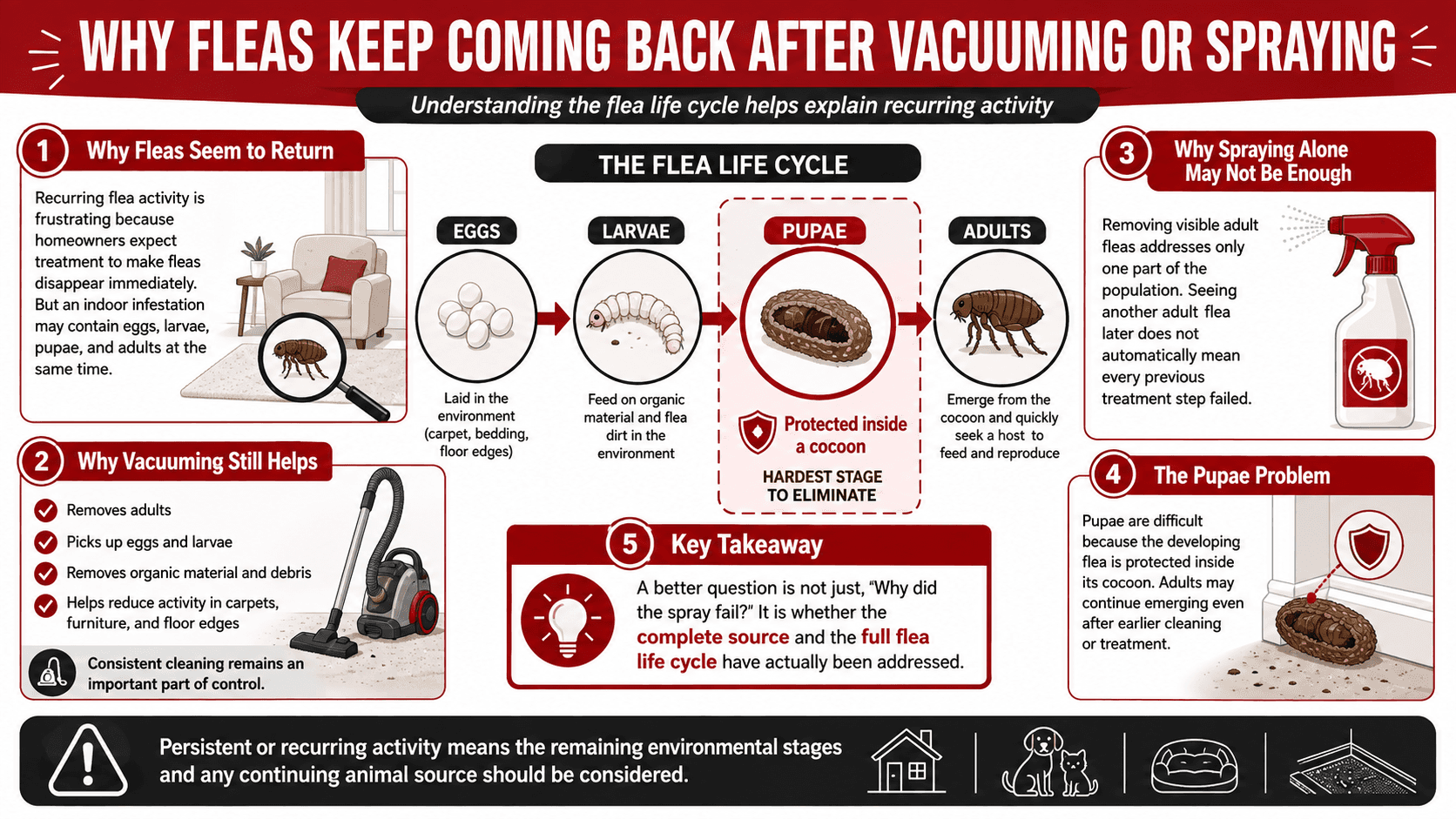
Why Fleas Keep Coming Back After Vacuuming or Spraying
Recurring flea activity often becomes frustrating because homeowners expect every treatment to produce immediate disappearance.
The flea life cycle helps explain why this does not always happen. An established indoor population may contain eggs, larvae, pupae, and adults at the same time. Removing the visible adults addresses only one part of that population.
Vacuuming remains useful because it can remove adults, eggs, larvae, organic material, and debris from carpets, furniture, floor edges, and other areas. Consistent cleaning can therefore play an important role in reducing flea activity.
Pupae create a particular challenge because the developing flea is protected inside its cocoon. Adults may continue emerging after previous cleaning or treatment has taken place.
Seeing another adult flea does not automatically mean every previous treatment step failed. Persistent or recurring activity does mean the remaining environmental stages and any continuing animal source should be considered.
A better question is not simply, “Why did the spray fail?” Ask whether the complete source and life cycle have actually been addressed.
Why Finding the Source Matters More Than Killing the Fleas You See
Imagine one Bristol home where adult fleas are treated throughout the living area while mice remain active inside the crawl space. The visible population may decline temporarily, yet an ongoing host remains nearby.
Consider another home where the rodent problem has already been resolved, but flea eggs, larvae, and pupae remain in carpets and protected indoor areas. Removing the animal source does not immediately remove every flea stage already present in the environment.
Both situations show why flea control requires more than one narrow action.
The most useful approach considers three connected elements: the host or original source, the environment where flea stages are developing, and the flea life cycle itself.
Ignoring any one of those elements can make recurring activity difficult to explain.
When to Call for Flea Control in Bristol, TN
Professional help becomes more valuable when the source is not obvious or the flea problem continues despite reasonable cleaning efforts.
Consider requesting flea control when fleas appear even though no pets live in the home, the problem began shortly after moving into a previously occupied property, rodents are suspected, wildlife may be using sheltered structural areas, several rooms are affected, or activity continues after repeated cleaning and spot treatments.
Professional inspection is also useful when the insects themselves have not been clearly identified. Treating a suspected flea problem without confirming the pest can send the entire process in the wrong direction.
Pest Detectives provides professional flea and mite control for Bristol and surrounding Tri-Cities communities.
How Pest Detectives Approaches Flea Problems in Pet-Free Bristol Homes
A pet-free flea problem often requires more investigation because there is no obvious dog or cat to provide an immediate explanation.
Pest Detectives begins by determining whether flea activity is actually present and identifying areas where activity appears strongest. Property history, animal evidence, environmental conditions, and the pattern of flea sightings can then help narrow the possible source.
Confirm the Pest
Bites alone do not confirm fleas. Inspection helps establish whether fleas are present before a treatment plan is built around them.
Investigate the Likely Source
Previous pets, rodents, wildlife, animal nesting, or environmental flea stages may all be relevant depending on the property. The most likely explanation should come from the evidence found during the inspection rather than from the simple fact that no pets currently live inside.
Focus on High-Activity Areas
Carpeting, rugs, furniture, floor edges, baseboards, garages, utility areas, crawl-space transitions, and former animal resting areas may deserve additional attention depending on where activity has been reported.
Account for the Flea Life Cycle
Visible adult fleas represent only one stage. Effective treatment planning needs to account for the broader environmental population and the possibility of adults continuing to emerge from previously established flea stages.
Reduce Conditions That Can Support Recurrence
Long-term control may also involve addressing hidden animal activity, likely source areas, structural entry conditions, environmental hot spots, cleaning recommendations, and follow-up where appropriate.
This source-focused approach is particularly valuable in a Bristol home where there is no current pet to explain why fleas are appearing.
Frequently Asked Questions About Fleas in Homes Without Pets
Q.1 Why do I have fleas if I don't have pets?
Fleas may remain from pets that previously lived in the property, emerge from environmental stages left in carpets or protected areas, arrive with rodents or wildlife, or occasionally be introduced by visiting animals and belongings. The property's history and the location of flea activity can help narrow down the source.
Q.2 Can fleas live in an empty house?
A vacant home can still contain developing flea stages. Flea pupae can remain protected inside cocoons and adults may become noticeable once people begin moving through and occupying the property again.
Q.3 Can mice bring fleas into the house?
Mice can carry fleas. Rodent droppings, gnaw marks, scratching sounds, nesting material, or activity around attics, crawl spaces, garages, and wall voids can make mice a more plausible source.
Q.4 Can fleas come from a crawl space?
Flea problems can be associated with rodents or wildlife using a crawl space. Activity concentrated near crawl-space access becomes more meaningful when other signs of animals are present.
Q.5 Why did fleas appear after I moved into the house?
The previous occupants may have owned pets, while flea stages remained in the property during a vacancy. Movement, warmth, pressure, vibration, and carbon dioxide associated with new occupants can contribute to adult fleas becoming noticeable.
Q.6 Who Provides Flea Control in Bristol, TN?
Pest Detectives provides flea and mite control for Bristol and other communities throughout the Tri-Cities. Their approach includes identifying the pest, investigating possible sources, examining high-activity areas, addressing the flea life cycle, and providing appropriate treatment and follow-up recommendations.
Finding Fleas in Your Bristol Home Even Without Pets?
A flea problem without a dog or cat can seem mysterious at first, but the property usually contains clues. The timing of the first sightings, previous occupants, periods of vacancy, rodent evidence, wildlife activity, recently introduced belongings, and the rooms where fleas are most active can all help narrow down what is happening. Treating visible adult fleas is only part of the process when the source remains active or immature flea stages are still developing in the environment.
If fleas continue appearing in your Bristol home and you cannot determine where they are coming from, contact Pest Detectives to discuss professional flea and mite control.


