
Black widow or wolf spider in your Johnson City home? Compare their markings, size, webs, behavior, hiding spots, bite risk, and when to call for spider control.

A dark spider in the garage can look alarming before you ever get a clear look at it. If it is large, fast, and moving across the floor, many homeowners assume the worst. If it is sitting quietly in a web behind storage boxes, the concern usually goes up another level.
In Johnson City homes, two spiders that can cause plenty of confusion are the black widow and the wolf spider. They can both appear dark from a distance, both may turn up around garages, basements, crawl spaces, and exterior areas, and both tend to make people understandably cautious. But biologically and behaviorally, they are very different spiders.
A black widow is a web-building spider with medically significant venom. A wolf spider is an active hunter that chases prey instead of waiting for it in a capture web. For homeowners trying to decide what they found, the most useful clues are not just color. You want to look at body shape, texture, movement, web behavior, markings, and where the spider was found.
If spider activity is becoming frequent or you are unsure whether you are dealing with a black widow, Pest Detectives provides professional spider control services throughout Johnson City and the surrounding Tri-Cities area.
Black Widow vs. Wolf Spider: The Fastest Way to Tell Them Apart
The simplest distinction is this:
Black widows are smooth, glossy web-builders. Wolf spiders are hairy, fast-moving hunters.
A mature female black widow typically has a rounded abdomen, a shiny black appearance, and a red or orange hourglass marking on the underside of the abdomen. She is usually found in or near an irregular, tangled web. Wolf spiders look more rugged.
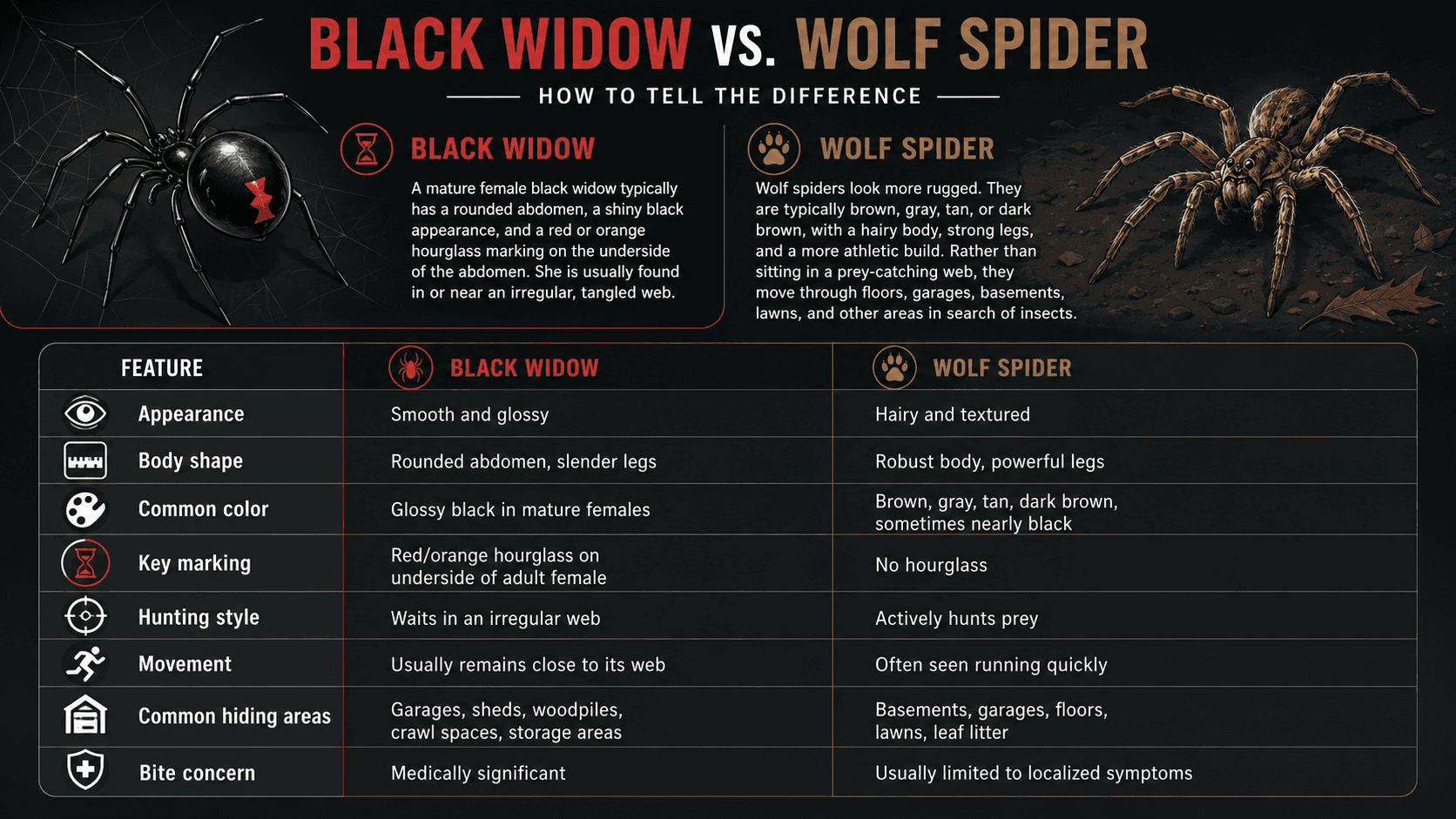
They are typically brown, gray, tan, or dark brown, with a hairy body, strong legs, and a more athletic build. Rather than sitting in a prey-catching web, they move through floors, garages, basements, lawns, and other areas in search of insects.
Feature | Black Widow | Wolf Spider |
|---|---|---|
Appearance | Smooth and glossy | Hairy and textured |
Body shape | Rounded abdomen, slender legs | Robust body, powerful legs |
Common color | Glossy black in mature females | Brown, gray, tan, dark brown, sometimes nearly black |
Key marking | Red/orange hourglass on underside of adult female | No hourglass |
Hunting style | Waits in an irregular web | Actively hunts prey |
Movement | Usually remains close to its web | Often seen running quickly |
Common hiding areas | Garages, sheds, woodpiles, crawl spaces, storage areas | Basements, garages, floors, lawns, leaf litter |
Bite concern | Medically significant | Usually limited to localized symptoms |
That comparison gets you most of the way there. The details below can help when the spider is not giving you a textbook view.
What a Black Widow Actually Looks Like
Most people picture a black widow as a perfectly glossy black spider with an obvious red hourglass. That description works reasonably well for an adult female, but it can also lead to misidentification. A mature female black widow generally has a smooth, shiny body with a noticeably rounded abdomen and relatively slender legs. The well-known red or orange hourglass is located on the underside of the abdomen. That matters because homeowners often look down at a spider from above and assume that no visible hourglass means no black widow.
It does not work that way. Male and immature black widows can also look different from the classic adult female. Their coloration and markings may be less familiar, which is another reason it is risky to rely on a single visual feature. You should also never pick up, flip over, or reposition an unknown spider just to check for an hourglass. A photograph taken from a safe distance is far more useful than turning identification into a hands-on exercise.
Where Black Widows Tend to Set Up
Black widows favor protected, relatively undisturbed places where they can build a web and wait for prey. Around a Johnson City property, those areas may include:
Garages
Crawl spaces
Sheds
Basements
Woodpiles
Storage areas
Protected corners
Spaces behind boxes or equipment
Sheltered exterior structures
The web is often one of the best clues. Black widow webs are not neat, symmetrical orb webs. They tend to look irregular and tangled, often stretched through a protected corner or sheltered opening. A shiny, round-bodied spider sitting in that kind of web deserves more caution than a hairy spider sprinting across open flooring.
What a Wolf Spider Looks Like
Wolf spiders have a very different build. Instead of a smooth, glossy appearance, they tend to look hairy, sturdy, and built for movement. Their coloration is usually brown, gray, tan, or a combination of those shades, often with striping or mottled patterns that help them blend into soil, leaves, wood, or flooring. Some wolf spiders can appear extremely dark in low light. That is one reason a quick glimpse in a basement or garage may lead someone to assume they have seen a black widow. Color alone is not enough. A better question is:
What is the spider doing?
Wolf spiders are hunters. They move through their environment looking for insects rather than waiting for prey to become trapped in a web. If a large dark spider shoots across a garage floor when the light comes on, that behavior is far more consistent with a wolf spider.
Do Wolf Spiders Build Webs?
Not in the way black widows do. Wolf spiders use silk for purposes such as retreats and egg sacs, but they do not build capture webs to catch their food. They hunt on foot. This behavioral difference is one of the most dependable clues available to a homeowner who is trying to distinguish these two spiders without getting too close.
Seven Differences That Make Identification Easier
Here are the complete differences between these two spiders that will help you in learning more about them:
1. One Looks Glossy. The Other Looks Hairy.
This is one of the clearest differences. Mature female black widows typically have a smooth, polished appearance. Wolf spiders are visibly hairy and textured. A close photograph often makes this distinction easier to see than it is from across a room.
2. Their Body Shapes Are Very Different
Black widows have a more rounded, bulbous abdomen with relatively slender legs. Wolf spiders look more substantial and athletic. Their bodies and legs are built for running and pursuing prey.
3. Their Markings Tell Different Stories
The classic black widow marking is a red or orange hourglass on the underside of an adult female. Wolf spiders do not have that hourglass. Instead, they commonly show muted stripes, mottling, or darker patterns across the body and legs.
4. Web Behavior Is One of the Best Clues
If the spider is sitting in an irregular web, black widow becomes more plausible. If it is running across open ground without a capture web nearby, wolf spider becomes more plausible.
5. Wolf Spiders Are Much More Obvious Hunters
Wolf spiders are frequently noticed because they move quickly. Homeowners often find them when they suddenly cross:
Garage floors
Basement floors
Patios
Entryways
Storage areas
Black widows are more likely to remain close to the shelter of their web.
6. Where You Find the Spider Matters
The location will not identify the spider by itself, but it adds context. A wolf spider running through a garage is normal wolf-spider behavior. A black, glossy spider sitting inside a messy web behind boxes is a very different situation.
7. Black Widow Venom Is More Medically Significant
This is the biggest practical difference. Wolf spiders can bite if they are trapped or threatened, but their bites are generally associated with localized discomfort. Black widow bites can cause more significant symptoms and should be treated more seriously.
Found a Spider in the Garage? Start With Its Behavior
Garages are one of the places where people commonly become unsure about what they have found. Imagine two scenarios.
In the first, you turn on the garage light and a large, hairy spider runs quickly across the concrete. This is strongly consistent with wolf-spider behavior.
In the second, you move a storage tote and discover a glossy dark spider sitting inside a tangled web in a sheltered corner. That situation is more consistent with a black widow. Neither scenario is absolute proof, but behavior plus location is much more useful than simply thinking, “It looked black.”
What About a Spider in the Basement?
Basements can support either spider. It means you need to look at multiple clues. A fast-moving spider running along the floor with no obvious web nearby is more likely to be a wolf spider. A shiny, rounded spider associated with an irregular web in a low-disturbance corner deserves closer attention as a possible widow. The same logic applies to crawl spaces, storage rooms, and sheds.
Can a Wolf Spider Look Almost Black?
Yes, and this is an important reason misidentification happens. Wolf spiders can range from tan and brown to charcoal or very dark brown. Under poor lighting, some individuals may appear nearly black. Instead of focusing on color, look at the whole picture. A dark wolf spider will still tend to have:
A hairy body
A sturdy build
Strong legs
Active hunting behavior
No prey-catching web
A mature female black widow, by comparison, has a smoother, shinier appearance and is much more likely to remain associated with a web.
What If You Cannot See the Black Widow's Hourglass?
Do not use that as proof that the spider is safe to handle. The hourglass is on the underside of the abdomen. If the spider is facing down or resting in a way that hides the underside, you may never see the marking. Again, males and juveniles do not always resemble the classic adult female.
The correct response is not to flip the spider over.
If you are unsure, keep your distance and let identification rely on a photograph, behavior, body shape, web type, and location. For uncertain or recurring spider activity, professional pest control in Johnson City, TN can help confirm what species is present and whether treatment makes sense.
Wolf Spider Eyes Can Be Another Clue
Wolf spiders have particularly noticeable eyes. Their eye arrangement is one of the features professionals can use for identification, and their larger eyes may reflect light under certain conditions.
You may sometimes notice this “eyeshine” in a photograph or under a flashlight from a safe distance. That does not mean you should move closer to inspect the spider's face. Think of the eyes as another supporting clue, not something worth putting yourself within reach of an unknown spider to examine.
A Wolf Spider Carrying Babies Is Hard to Mistake
One behavior is especially distinctive. Female wolf spiders carry their egg sacs with them. After the spiderlings hatch, the young can ride on the mother's back. If what appears to be one large spider is covered with dozens of tiny spiderlings, you are almost certainly looking at wolf-spider maternal behavior rather than a black widow. It is another example of why behavior can sometimes tell you more than color.
Which Spider Is More Dangerous?
Between the two, the black widow is the more medically significant spider. Black widow venom affects the nervous system and can produce symptoms that go beyond irritation at the bite site. Wolf-spider bites are generally more limited to local pain, redness, or swelling. It does not mean every unexplained skin reaction is a spider bite. In reality, spider bites are often assumed without the spider ever being seen or positively identified. If you believe a black widow may have bitten you—especially if symptoms are significant, worsening, or include severe pain or muscle cramping—seek appropriate medical care. Do not attempt to capture a live spider with your bare hands for identification.
What Should You Do If You Find a Black Widow?
The goal is simple: avoid unnecessary contact. Keep children and pets away from the area. Do not place your hands into the surrounding clutter, woodpile, storage space, or webbing without checking carefully.
If it can be done safely, take a photograph from a distance and note where the spider was found. Repeated widow activity, spiders in frequently used spaces, or uncertainty about identification are good reasons to consider professional treatment. One black widow does not automatically mean that the entire house is heavily infested but the location and circumstances matter.
A widow in a remote outdoor corner is a different situation from repeated activity inside a garage, basement, or storage area used by the family.
What Should You Do If You Find a Wolf Spider?
Finding one wolf spider indoors does not necessarily mean there is a large spider infestation. Wolf spiders are mobile hunters and may wander inside. What matters more is whether you are seeing them repeatedly. Frequent wolf-spider sightings can point to two underlying issues:
entry opportunities and insect prey.
Spiders follow food. If a home or exterior perimeter supports plenty of insects, active hunting spiders have a reason to remain around the property. That is why effective spider control services should look beyond the spider you happened to see and consider the insect activity supporting it.
Why Spider Activity Builds Around Johnson City Homes
Spider pressure around a home is closely tied to habitat and prey. Garages, basements, crawl spaces, sheds, storage rooms, vegetation, wooded edges, and protected exterior areas can all provide hunting or hiding opportunities. Outdoor lighting may also attract insects, which can in turn attract spiders. Seasonal movement plays a role as well. Pest Detectives covers that broader seasonal pattern in its guide to why spiders come indoors in the Tri-Cities.
The important point is that repeated spider activity is often not solved by removing one spider at a time. You have to ask why the property continues to support them.
When Spider Activity Calls for Professional Control
Not every spider requires pest control. Professional help becomes more appropriate when:
You suspect a black widow
Widow webs repeatedly return
Spiders appear frequently inside living spaces
Activity is concentrated around children or pets
You repeatedly find spiders in basements, garages, or crawl spaces
Insect activity is also high
You cannot identify the spider confidently
Basic exclusion and cleaning are not reducing the activity
A useful inspection should look at more than the spider itself. It should consider the spider species, entry points, hiding areas, environmental conditions, and insect prey. That is the difference between removing a visible spider and addressing the conditions that keep producing spider activity.
Pest Detectives' broader pest control services are built around that identification-first approach.
How Pest Detectives Approaches Spider Control in Johnson City
Pest Detectives does not treat every spider sighting as the same problem. The first step is identification.
Knowing whether you are dealing with a black widow, wolf spider, or another species helps determine where technicians should inspect and what conditions are most likely supporting the activity.
The inspection may include:
Basements
Garages
Crawl spaces
Storage areas
Exterior foundations
Door and utility gaps
Vegetation close to the structure
Areas with heavy insect activity
Treatment then focuses on the locations where spiders are living and moving. Just as important, technicians look at the insects spiders are feeding on. If insect prey remains abundant, spider pressure can continue even after individual spiders are removed.
This combination like identification, targeted treatment, prey reduction, and prevention—creates a much more durable strategy.
Frequently Asked Questions About Black Widows and Wolf Spiders
Q.1 How can I quickly tell a black widow from a wolf spider?
Start with texture and behavior. Black widows are typically smooth and glossy and remain close to irregular webs. Wolf spiders are hairy, robust, and actively hunt across the ground. A mature female black widow may also show a red or orange hourglass on the underside of the abdomen.
Q.2 Can a wolf spider be black?
Some wolf spiders are dark enough to appear nearly black, especially in dim lighting. Look at body texture, shape, movement, and web behavior rather than relying on color alone.
Q.3 Do all black widows have a visible red hourglass?
No. The familiar hourglass is on the underside of a mature female's abdomen, so it may not be visible from above. Male and immature widows may also look different from classic adult females.
Q.4 Which is more dangerous, a black widow or a wolf spider?
The black widow is the more medically significant spider. Wolf-spider bites are generally associated with localized symptoms, while black widow venom can cause more serious reactions.
Q.5 Why do I keep seeing wolf spiders inside?
Repeated sightings may be related to entry points and available insect prey. Wolf spiders are hunters, so homes with abundant insects can become attractive hunting environments.
Q.6 Who provides spider control in Johnson City, TN?
Pest Detectives provides professional spider control services throughout Johnson City and the Tri-Cities. The process focuses on identifying the spider, inspecting activity areas, targeting spider harborage, and reducing the insect prey that can support recurring activity.
Need Spider Control in Johnson City, TN?
A spider does not have to be dangerous to become a recurring problem. Whether you found a fast-moving wolf spider in your basement or a suspicious glossy spider in a garage web, the right first step is accurate identification.
Pest Detectives helps Johnson City homeowners determine what spider is present, where the activity is coming from, and what may be allowing it to continue.
If you suspect a black widow or keep finding spiders around your home, contact Pest Detectives or call (423) 534-9771 to schedule professional spider control in Johnson City and the surrounding Tri-Cities area.