

Found termite activity around a Bristol, TN deck or porch? Learn the warning signs, when your home may be at risk, and when to schedule a termite inspection.

A thin mud colored tube climbing a deck post can be easy to dismiss. So can a soft section of wood beneath the porch, a damaged stair stringer, or a handful of wings caught near the foundation. The problem is that these small signs may be the first visible evidence of termite activity in an area homeowners rarely inspect closely.
Finding termites around a deck or porch does not automatically mean termites are already inside your Bristol home. The location of the activity matters just as much as the activity itself. Evidence around an attached deck, porch support, foundation, ledger board, or crawl space deserves considerably more attention because these areas can connect exterior termite activity with the structure of the house.
If you are unsure what you have found, Pest Detectives provides professional termite treatment services throughout Bristol and the surrounding Tri Cities area.
Termites Around Decks and Porches in Bristol, TN
Termites in a deck do not automatically prove that the home itself has a termite infestation. A colony may be feeding on exterior wood without having reached the house, particularly when the affected wood is detached or located away from the foundation.
Concern rises when termite evidence appears on a structure physically connected to the home. Mud tubes on deck posts, damaged porch supports, weakened framing close to the foundation, or activity where the deck joins the house all deserve further investigation.
The most important question is not simply, “Are there termites in the deck?” It is, “Where does the evidence lead?”
What You Found | Concern Level | Why It Matters |
|---|---|---|
Termites in old exterior wood away from the house | Lower | Exterior activity alone does not confirm structural infestation |
Activity beneath a detached deck | Moderate | Nearby soil, moisture, and the distance from the home still need consideration |
Mud tube on a deck post | High | The tube may represent a subterranean termite travel route |
Damage where an attached deck meets the house | High | The affected area connects directly with house framing |
Mud tube on the foundation | Very High | Termite activity is immediately adjacent to the structure |
Damaged porch supports against the home | High | Concealed access toward structural wood may be possible |
Why Decks and Porches Can Become Termite Entry Routes
Decks and porches spend their entire service life exposed to soil, rain, shade, drainage patterns, and changing moisture conditions. Those characteristics do not mean termites will automatically appear, but they can create conditions in which subterranean termites have easier access to structural wood.
Wood to Soil Contact
Subterranean termites live primarily in the soil and travel outward in search of cellulose based materials. Deck posts, wooden steps, porch supports, stair stringers, landscaping timbers, or buried wood can reduce the amount of exposed ground termites need to cross before reaching a food source.
A post touching soil is not proof of an infestation. It does, however, remove some of the separation between underground termite activity and the wooden components above.
The same concern applies when mulch, soil, leaves, or landscape material accumulates against wooden portions of a deck or porch. These conditions can make inspection more difficult while creating concealed areas close to the structure.
Moisture Under the Structure
Persistent moisture can make areas beneath decks and porches more favorable for termite activity. Poor drainage, overflowing gutters, leaking downspouts, shaded soil, plumbing leaks, and water collecting near footings can all keep the surrounding environment damp.
Moisture does not create termites. It can, however, contribute to the type of conditions subterranean termites frequently exploit while also accelerating decay in wooden materials.
Homeowners looking for pest control in Bristol, TN should pay particular attention when pest evidence appears alongside recurring moisture problems around the exterior of the home.
Concealed Areas Beneath Decks and Porches
An open deck may look easy to inspect from above, yet much of the structural wood sits underneath the walking surface. Posts, beams, joists, stair supports, fastened connections, and the back side of the ledger can remain outside normal sightlines.
Porches may create an even larger inspection challenge. Skirting, lattice, masonry, enclosed voids, low clearances, and finished surfaces can hide areas where termite activity would otherwise be visible.
Direct Connection to the House
An attached deck creates something a detached deck does not: a structural pathway directly beside the home.
Many attached decks connect through a ledger board fastened near the rim or band joist. Siding, flashing, foundation materials, structural framing, and concealed wood may all meet within a relatively small area.
The concern is therefore not limited to whether termites are eating the deck. The larger question is whether termite activity has reached wood connected to the house.
7 Signs of Termites Around a Deck or Porch
Termite activity around outdoor structures can appear in several forms. No single symptom should be interpreted without context, particularly when moisture damage, aging lumber, and ordinary deterioration may be present at the same time.
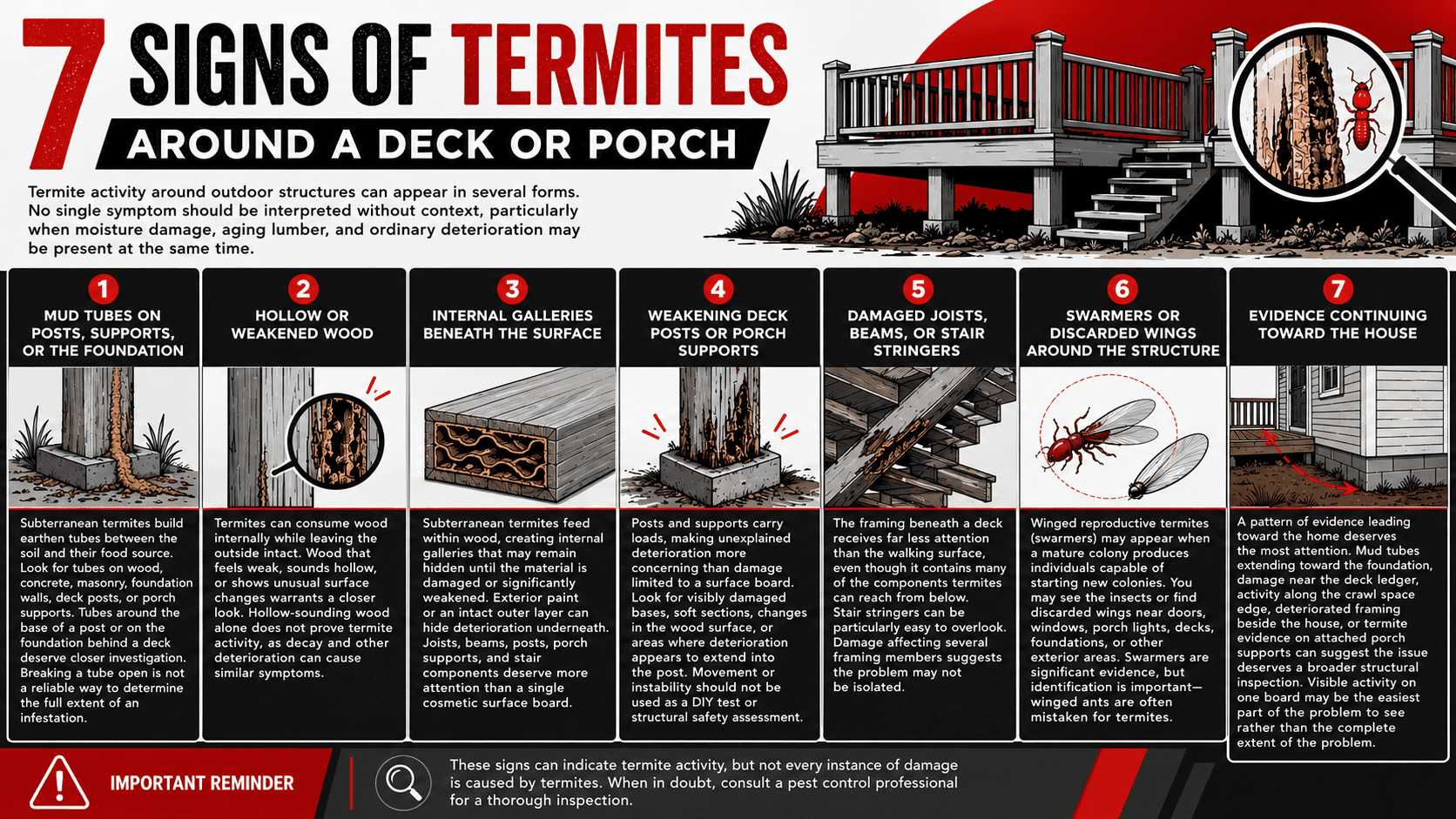
1. Mud Tubes on Posts, Supports, or the Foundation
Subterranean termites commonly build shelter tubes between the soil and the areas where they are feeding. These tubes usually have an earthen or mud like appearance and may run vertically along wood, concrete, masonry, foundation walls, deck posts, or porch supports.
A tube around the base of a post deserves attention because it may indicate termite movement from the soil toward the structure. Tubes appearing on the foundation behind a deck deserve even closer investigation.
Breaking a tube open is not a reliable way for a homeowner to determine the full status of an infestation. Termite movement may exist elsewhere even when insects are not immediately visible inside one damaged section of tubing.
2. Hollow or Weakened Wood
Termites can consume wood internally while leaving portions of the exterior surface intact. A board, post, joist, or support may therefore appear relatively normal until deterioration becomes more advanced.
Wood that feels unexpectedly weak, sounds hollow in certain areas, or shows unusual surface changes warrants a closer look. Hollow sounding wood alone does not prove termite activity, since decay and other forms of deterioration can produce similar symptoms.
3. Internal Galleries Beneath the Surface
Subterranean termites feed within wood, creating internal galleries that may remain concealed until the material is damaged, opened, or significantly weakened. Exterior paint or an intact outer layer can sometimes hide deterioration underneath.
Joists, beams, posts, porch supports, and stair components deserve more attention than a single cosmetic surface board because they contribute to the structure as a whole.
4. Weakening Deck Posts or Porch Supports
Posts and supports carry loads, which makes unexplained deterioration in these areas more concerning than damage limited to an easily replaceable surface component.
Look for visibly damaged bases, soft sections, changes in the wood surface, or areas where deterioration appears to extend into the post. Movement or instability should not be used as a do it yourself termite test or structural safety assessment. Suspected structural problems should be evaluated by the appropriate professional.
5. Damaged Joists, Beams, or Stair Stringers
The framing beneath a deck receives far less attention than the walking surface, even though it contains many of the components termites can reach from below.
Stair stringers can be particularly easy to overlook. Their lower portions may sit close to soil, mulch, vegetation, concrete, or persistently damp surfaces, especially around older exterior structures.
Damage affecting several framing members deserves more concern than a single weathered board because it suggests the problem may not be isolated.
6. Swarmers or Discarded Wings Around the Structure
Winged reproductive termites, commonly called swarmers, may appear when a mature colony produces individuals capable of establishing new colonies. Homeowners may notice the insects themselves or find discarded wings near doors, windows, porch lights, decks, foundations, or other exterior areas.
Swarmers are significant termite evidence, although wings by themselves do not reveal the exact location of the colony. Identification also matters because winged ants are frequently confused with termite swarmers.
7. Evidence Continuing Toward the House
A pattern of evidence leading toward the home deserves the greatest attention.
Mud tubes extending toward the foundation, damage near the deck ledger, activity along the crawl space edge, deteriorated framing immediately beside the house, or termite evidence on attached porch supports can suggest that the issue deserves a broader structural inspection.
Visible activity on one board may be the easiest part of the problem to see rather than the complete extent of the problem.
Do Termites in the Deck Mean They Are Already in the House?
No. Finding termites in or around a deck does not automatically mean termites are already inside the house.
Subterranean termites forage through soil and may encounter many sources of cellulose around a property. Old lumber, buried wood, tree material, detached structures, landscaping timbers, and other exterior materials can support termite activity without proving that the colony has entered the home.
Location changes the risk assessment.
Termites discovered in an old piece of wood well away from the house represent a different situation from mud tubes discovered behind an attached deck. Activity at the ledger, foundation, porch connection, crawl space edge, or house framing should be treated as a reason to inspect beyond the visibly affected area.
An inspection becomes particularly important when the deck is attached to the home, the porch shares structural connections with the building, mud tubes appear directly on the foundation, several termite signs occur in the same area, or damaged wood is found close to the crawl space.
A professional termite inspection in Bristol, TN can help determine whether the evidence is limited to the exterior structure or whether additional areas of the property require attention.
Attached Deck vs. Detached Deck: Why the Difference Matters
An attached deck has a direct relationship with the house. Its ledger may connect to the building near siding, flashing, the rim joist, foundation components, and other structural materials. Termite evidence at this connection therefore deserves more scrutiny because the insects are already close to house connected wood.
A detached deck does not create the same direct structural pathway. Termite activity beneath a detached structure may still reveal conducive conditions in the surrounding soil, particularly when moisture, wood contact, or nearby cellulose sources are present.
Distance alone should never be treated as a guarantee. A detached deck is not automatically safe simply because there is space between the deck and the home. The surrounding property, proximity to the foundation, soil conditions, and location of the termite evidence still matter.
Check These 6 Parts of the Deck First
A deck is a system of connected components. Looking only at the boards beneath your feet can leave many of the most important areas unchecked.
1. Deck Posts
Examine the visible portions of posts, particularly near the base. Look for mud tubes, damaged wood, unusual soft areas, and places where soil or landscaping material contacts the post.
2. Post Bases and Footings
The transition between the ground and the deck deserves careful attention. Damp soil, concealed gaps, cracks around the footing, shelter tubes, and accumulated debris can make termite evidence difficult to notice.
3. Joists and Beams
Joists and beams sit below the deck surface and may remain shaded for much of the day. Inspect visible framing for suspicious damage, tubes, or deterioration rather than judging the deck solely by the condition of the top boards.
4. Stair Stringers
Stair stringers frequently extend close to soil, mulch, pavement, or damp surfaces. Their position also means damage can develop in an area homeowners rarely examine unless the stairs begin showing obvious problems.
5. Ledger Board
The ledger is one of the most important areas on an attached deck because it forms the connection between the deck and the house. Evidence in this location changes the question from exterior deck damage to possible involvement of house connected framing.
6. Foundation Behind or Beneath the Deck
The foundation can be difficult to inspect once a deck is built in front of it. Visible foundation sections behind posts, stairs, or framing should be checked for shelter tubes, suspicious transitions, cracks, and termite evidence extending upward toward structural materials.
Why the Deck Ledger Board Deserves Special Attention
The ledger board is the structural component that connects many attached decks to the home. Its location makes it especially important during a termite inspection because the area can contain several layers of materials within a small space.
Siding may cover part of the connection. Flashing can conceal edges. The rim or band joist may sit immediately behind the exterior surface, while moisture intrusion can make the area more vulnerable to deterioration.
Termite activity near the ledger therefore raises a different question than activity in a freestanding deck board.
The concern becomes whether termite evidence extends into the framing associated with the home.
Homeowners should not dismantle siding, remove structural components, or attempt to judge the safety of the ledger themselves. Inspection should focus on determining the extent and direction of termite activity before decisions are made about treatment or repair.
Why Termites Under a Porch Can Be Harder to Spot
Porches can hide termite activity more effectively than open decks because their construction often creates areas that cannot be easily viewed from the exterior.
A porch may include enclosed supports, wooden stairs, skirting, masonry, low clearance spaces, concealed foundation sections, or framing hidden behind finished surfaces. Some designs also contain enclosed or earth filled spaces that significantly restrict visibility.
A homeowner may therefore notice deterioration on one exposed porch support while other relevant areas remain hidden. The visible sign is useful, but it does not necessarily show where the activity began or how far it extends.
Older porches deserve particular attention when moisture, settlement gaps, additions, repairs, or multiple generations of building materials have created concealed transitions around the home.
Porch construction can hide evidence that would be far easier to recognize beneath an open deck. Professional inspection becomes especially useful when the affected area cannot be viewed without disturbing the structure.
Termite Damage vs. Wood Rot on a Bristol Deck or Porch
Termite damage and wood rot can be difficult to distinguish when a deck or porch has been exposed to moisture for years. Both may result in weakened wood, soft areas, damaged surfaces, or deterioration around posts and stairs.
The two conditions are not mutually exclusive. Moisture can contribute to fungal decay while also creating conditions around the structure that are favorable for subterranean termite activity.
Sign | More Consistent With Termites | More Consistent With Wood Rot |
|---|---|---|
Mud or shelter tubes | Strong termite clue | Not typical |
Internal galleries | Common termite clue | Not typical |
Hollowed internal wood | Possible | Different deterioration pattern |
Fungal growth | Not diagnostic | More consistent with rot |
Wet or spongy wood | Can occur alongside termite activity | Common |
Persistent moisture | Favorable condition | Common driver |
Live termites | Strong confirmation | No |
Can appearance alone confirm the cause? | No | No |
Rot generally develops as fungi break down wood under suitable moisture conditions. Termites physically feed on cellulose and may create galleries inside the material.
Real properties are rarely as clean as a comparison chart. A leaking gutter can create damp wood, the damp wood can begin to decay, and termites may also exploit the surrounding conditions. Finding rot therefore does not rule out termites, just as finding termites does not mean every soft area was caused exclusively by termite feeding.
Can Termites Damage a Pressure Treated Deck?
Pressure treated lumber is designed to provide greater resistance to decay and insect attack, but it should not be treated as completely termite proof.
A deck contains more than its most visible treated boards. Cuts, drilled areas, aging wood, stair components, older repairs, adjoining house framing, and other materials may not provide the same level of resistance.
Conditions around the deck matter as well. Persistent moisture, soil contact, hidden framing, and activity close to the foundation still deserve attention even when much of the visible structure was originally built from pressure treated lumber.
The presence of treated wood should therefore be considered one part of the property assessment rather than a guarantee against termite activity.
What About Composite Decking?
Composite decking can reduce the amount of exposed natural wood on the walking surface, but a composite deck does not automatically eliminate termite risk.
Many composite decks still rely on wooden posts, joists, beams, blocking, stairs, or ledger boards. The deck may also attach directly to conventional wood framing in the house.
Termites under a composite deck may therefore be feeding on structural components that are not visible from above.
The material used for the surface boards is only one part of the structure. Inspection should consider what supports the deck, what connects it to the house, and what materials are present beneath the finished surface.
Should You Replace a Damaged Deck Board Before a Termite Inspection?
Replacing a visibly damaged board may improve the appearance of the deck, but it does not answer the larger termite questions.
The damaged board does not reveal whether termites are still active elsewhere, whether nearby structural components are affected, whether the activity reaches the foundation, or whether concealed galleries are present in adjacent framing.
Removing evidence too early can also make it more difficult to understand the original pattern of activity.
When termite activity is suspected, document what you found and determine the extent of the problem before assuming the visible board represents the entire issue. Repairs and termite control solve different problems, and the appropriate sequence depends on what the inspection reveals.
What Should Bristol Homeowners Do After Finding Exterior Termite Activity?
Finding suspicious activity does not require tearing apart the deck or opening the porch. A few practical steps can preserve useful evidence while helping you identify whether professional inspection is appropriate.
Document What You Found
Take clear photographs of mud tubes, damaged wood, wings, suspicious post bases, or other evidence before the area is disturbed. Photograph the surrounding area as well so the location can be understood in relation to the house.
Check the House Connection
Visually examine accessible areas around the ledger, foundation, porch connection, and crawl space edge. Look for similar evidence continuing toward the structure without removing siding or dismantling framing.
Do Not Assume the Problem Is Limited to One Board
The easiest damage to see is not always the only damage present. Termites can remain concealed inside wood, behind finishes, beneath porches, or along foundation areas that receive little routine attention.
Address Obvious Moisture Problems
Standing water, clogged or leaking gutters, poor drainage, and recurring moisture beneath the structure should be corrected when practical. Moisture correction can improve the conditions around the property, but it does not eliminate an established termite colony by itself.
Schedule an Inspection When Evidence Is Near the House
Activity on an attached deck, porch, foundation, ledger, or house connected framing deserves professional attention because visual inspection from the exterior cannot always establish the full extent of the problem.
When to Schedule a Termite Inspection in Bristol, TN
Professional inspection becomes particularly important when the termite evidence is close to structural components rather than isolated in distant exterior wood.
Schedule an inspection when you find mud tubes on posts or foundation surfaces, termite activity on an attached deck, damage around porch supports, weakened structural wood, swarmers close to the house, activity around the ledger board, or suspicious damage near crawl space framing.
Inspection is also worthwhile when wood rot and termite damage are difficult to distinguish. Moisture damaged decks can produce confusing symptoms, and treating the wrong problem can leave the real cause unresolved.
Several signs appearing in the same part of the property should raise the priority. For example, a damaged deck post accompanied by a mud tube and persistent moisture near the foundation provides far more useful context than one weathered board by itself.
Pest Detectives can perform a termite inspection in Bristol, TN and evaluate whether the evidence appears limited to the exterior structure or requires a broader termite control plan.
How Pest Detectives Handles Termite Activity Around Bristol Homes
Effective termite control starts by understanding where the activity is occurring and how the surrounding structure is built. Treating the first visible piece of damaged wood without examining nearby areas can miss the conditions allowing termite activity to continue.
Inspect the Evidence
The first step is determining whether the signs are consistent with termites. Mud tubes, damaged wood, swarmers, structural location, moisture, and surrounding conditions all contribute to the assessment.
Follow Activity Toward the Structure
Inspection may extend beyond the visibly damaged deck component to nearby posts, porch areas, foundation surfaces, crawl space edges, and structural connections. The objective is to understand whether exterior evidence appears isolated or connected to additional parts of the property.
Identify Conducive Conditions
Moisture, wood contact, drainage problems, hidden access points, and difficult to inspect areas can all influence termite risk. Correcting these conditions can form an important part of long term property protection.
Develop a Treatment Plan
Termite treatment should reflect the location of activity, property layout, structural conditions, and inspection findings. Pest Detectives may recommend professional liquid treatment, a termite bait system, or an appropriate combination depending on the property.
The right method is the one that fits the infestation and structure rather than a single approach applied to every home.
Prevention and Follow Up
Termite control may also include monitoring, recommendations for reducing conducive conditions, and follow up based on the treatment plan and property risk.
Homeowners dealing with additional pest activity can review Pest Detectives' broader pest control services, while those specifically concerned about termites can learn more about Pest Detectives termite treatment services.
Frequently Asked Questions About Termites Around Bristol Decks and Porches
Q.1 Do termites in my deck mean my Bristol home has termites?
No. Termites in a deck do not automatically confirm that the house is infested. Activity becomes more concerning when the deck is attached to the home or when evidence appears near the foundation, ledger, crawl space, porch connection, or house framing.
Q.2 Can termites move from an attached deck into a house?
An attached deck places wooden components close to or directly against house connected framing. Subterranean termites can travel from soil into accessible wood, so evidence near the deck to house connection warrants inspection. Finding activity there still does not prove how far the termites have traveled without further evaluation.
Q.3 What do termite mud tubes look like on deck posts?
Subterranean termite shelter tubes generally look like narrow earthen or mud colored lines built along surfaces. They may appear on wood, concrete, masonry, foundation walls, posts, or other materials between the soil and a feeding area.
Q.4 Can termites damage pressure treated decking?
Pressure treatment increases resistance to termite attack, but the deck should not be considered completely termite proof. Aging wood, cut areas, framing, stairs, adjoining structural materials, and house connected wood may still require inspection.
Q.5 Can termites be under a composite deck?
Yes. Composite surface boards do not mean the entire deck is made from composite material. Wooden joists, beams, posts, ledger boards, stair components, or house framing may still be present beneath or beside the decking.
Q.6 Who provides termite inspections in Bristol, TN?
Pest Detectives provides professional termite inspection and treatment services for Bristol and surrounding communities in the Tri Cities area. The team can inspect visible evidence, evaluate nearby structural areas, identify conditions associated with termite activity, and recommend an appropriate treatment strategy.
Found Termite Activity Around Your Bristol Deck or Porch?
Mud tubes, damaged posts, weakened framing, swarmers, or suspicious activity where a deck or porch meets the house should not be dismissed as an exterior wood problem without looking at the surrounding structure.
Pest Detectives can inspect the affected area, examine the nearby foundation and house connections, and determine whether termite control is appropriate for the property.
If you have found suspicious termite activity around your Bristol home, contact Pest Detectives or call (423) 534-9771 to schedule an inspection.


